

On Tuesday I argued that “AI was used” tells you nothing about whether a piece of work is any good. Read the thing first, I said, and judge the work and who stands behind it.[1]
The same morning, the ABC published a story that looks, at first glance, like it argues the other way.[2]
A French tourist stayed with an Airbnb host in Hobart and, after a dispute about his check-out, left a one-star review. Two days later the host lodged a claim against him for $1,755, including a $1,500 invoice for “foreign object extraction”. The evidence was a photo of a blocked, overflowing toilet.
The guest suspected the photo was fake. The ABC ran the image through Google’s SynthID Detector, which found it had been made or edited with Google AI.[2] Airbnb rejected the claim, and the guest was fully refunded.
So here is a case where knowing that AI was involved told you exactly what you needed to know. Does that undo Tuesday’s argument?
What the work claims to be
I don’t think it does, but it does sharpen it.
An essay claims to be worth reading. You judge it by reading it. Whether the author drafted it with a pen, a keyboard or a language model doesn’t change whether the argument holds.
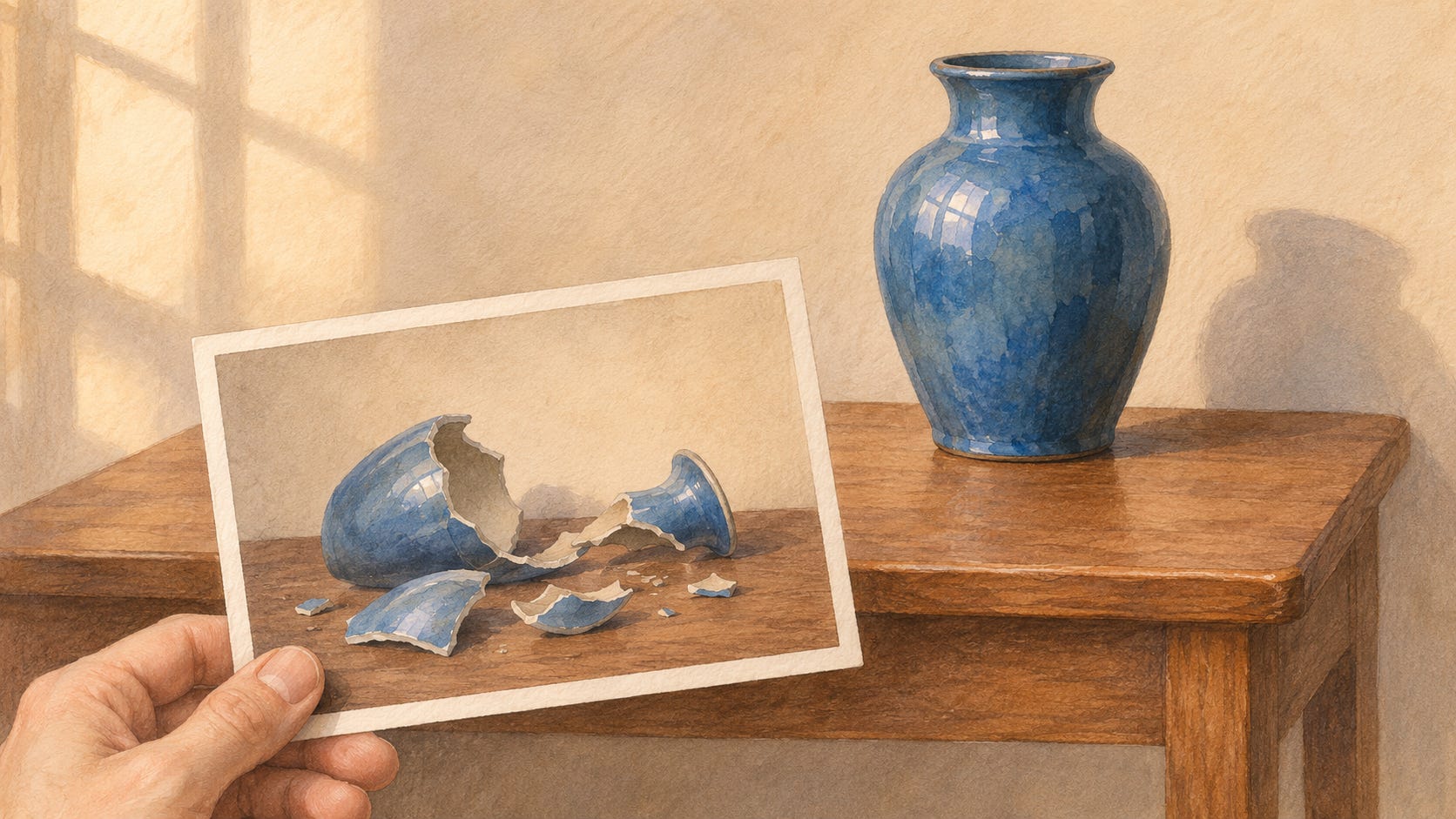
A photo attached to a damage claim makes a different claim. It isn’t there to be admired. It’s there to say “this happened”. Its craft is irrelevant; its whole value lies in being a true record. For that kind of work, where it came from is the work.
The rule is the same in both cases: judge the work by what it claims to be. It’s just that some work claims to be evidence.
In August I wrote that a watermark can show, at most, that a model was likely involved, and that “likely involved” is not the same as “AI wrote this”.[3] For an essay, that gap matters a great deal. For a photograph offered as proof, “likely involved” is all anyone needs to know.
The lie came first
There is another detail in the ABC’s story that is easy to miss. The invoices the host supplied named two businesses. Neither matched an existing business. “The ABNs listed were invalid, emails bounced, and there was no business of the kind at either address.”[2]
None of that needed AI. A made-up business name and a made-up ABN take no technology at all. The photo was one more piece of the same lie. The problem was the dishonesty, not the tool used to carry it out.
The speedometer
I spent a fair part of my career pulling non-technical people back to earth after a vendor presentation. They would come back with glossy brochures, ready to commit to a new system, and it was my job to ask what the brochure was actually claiming.
One dashboard has stayed with me. It showed the number of deals closed on a dial that looked like a car’s speedometer or fuel gauge. It was beautiful, and it was meaningless. The number was a count, not measured against any target or limit, so there was no way to know whether the needle should sit near the bottom or near the top. The dial implied a scale that didn’t exist.
It was designed to entice buyers, and it was entirely misleading. No AI was involved. Just a design that claimed to measure something it didn’t.
That’s the habit worth keeping, whatever made the thing in front of you. Ask what it claims to be: an argument, a record, a measurement. Then ask whether it’s true. The tool is rarely the interesting question. The claim always is.
[1] Jim Karabatsos, “Judge the Work, Not the Tool”, Ground Truth, 3 November 2026.
[2] Jessica Black, “Airbnb host accused of using AI image of blocked toilet to claim damages”, ABC News, 3 November 2026.
[3] Jim Karabatsos, “The Ballpoint Pen Wants a Byline”, Ground Truth, August 2026.