

In 2010, the year my father died, I attended ten funerals.
Not my father’s – that came later. These were the funerals of people whose relationship to me had no clean English name. Not close family. Not friends in the sense my colleagues would recognise. Something denser and older than either: a web of connection with obligations that were real and binding and entirely impossible to explain to anyone who hadn’t grown up inside them.
I would tell my employer I needed to take a day’s leave. For what? A funeral. Whose? And there it would stall – because there was no English word for what these people were to me, and no English social norm that could explain why their death required me to be present, in person, on that day, without negotiation.
On the morning my father died, I had another funeral to attend. I went. The husband of the woman we were burying came to my house that evening to pay his respects. He had buried his wife that afternoon. He came to my house.
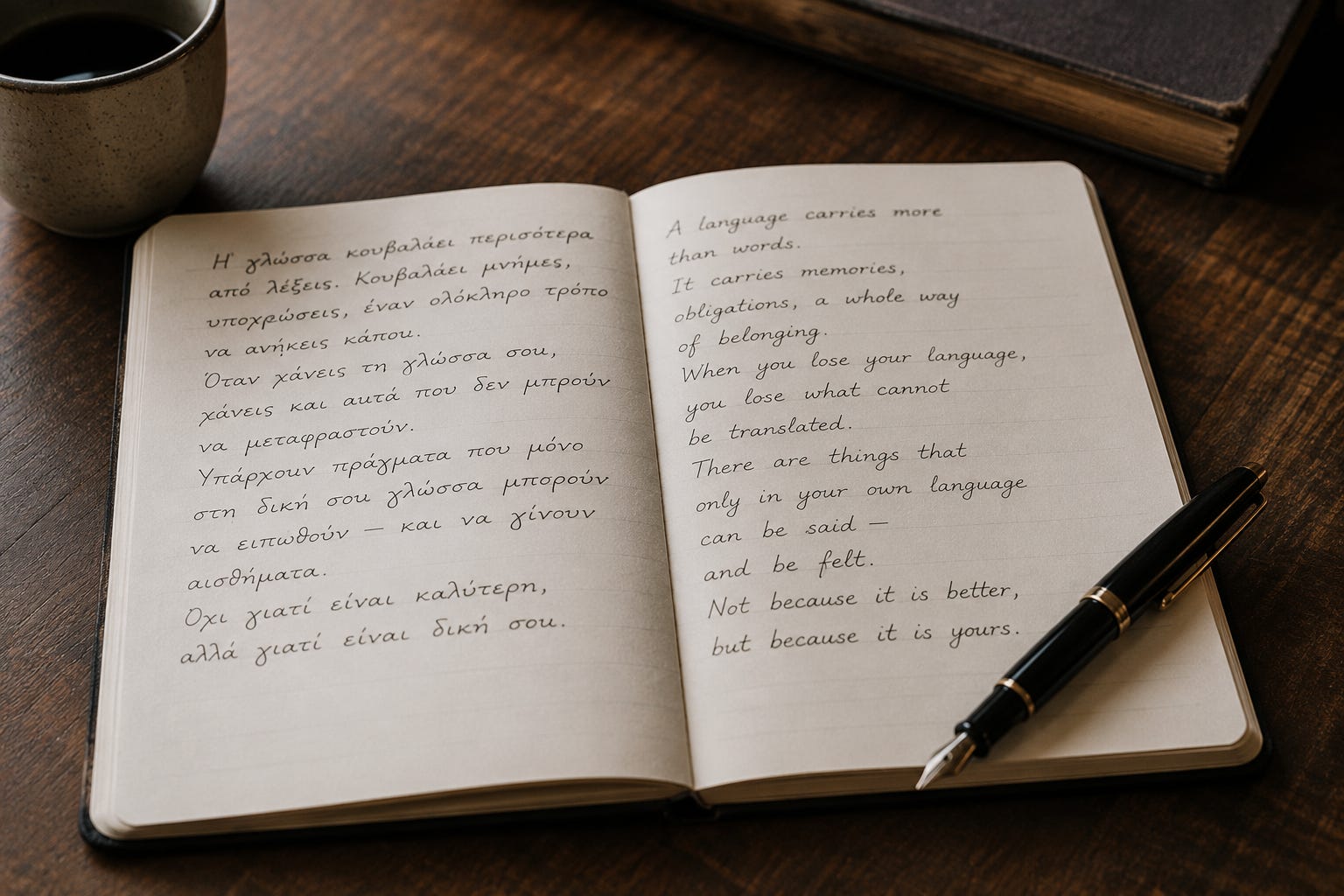
Is that language? Is it culture? I have been asking myself that question for sixty years, and I cannot separate the two. A language doesn’t just carry words. It carries obligations, relationships, the entire architecture of belonging. When you lose one, you lose both.
Greeks have a word for what I’ve been describing: filotimo (φιλότιμο). It translates literally as “love of honour” or “friend of honour,” which tells you almost nothing about what it actually means. Filotimo encompasses hospitality, community connection, personal honour, and social obligations so deeply embedded in Greek life that asking a Greek person to define it is like asking them to define “heavy.” They know what it is. Something either has it or doesn’t. No further explanation is available, or needed.
The man who came to my house on the night of my father’s death had filotimo. His presence was not an act of grief management or social performance. It was the automatic expression of a value so fundamental it required no decision. In English, I can explain that to you. But I cannot make you feel it the way a Greek person feels it – which is the whole problem.
I’ve tried to explain the difference between the two languages like this. A gifted writer in English can explain a feeling or emotion so that you understand it. A gifted writer in Greek can actually evoke that feeling in you. They are not the same thing.
The same thing happens in song, where the words are only the surface of what is being said. Here is a refrain from a popular Greek song, Ο Αετός – The Eagle:
Ο αετός πεθαίνει στον αέρα
ελεύθερος και δυνατός
της απονιάς όταν τον βρίσκει σφαίρα
τον αγκαλιάζει ο ουρανός.
The eagle dies in the air
free and powerful
when cruelty’s bullet finds it
the sky embraces it.
The English version is accurate. A non-Greek speaker can follow the narrative. But a Greek speaker cannot hear that verse without a lump in the throat – not because of the words, but because of the thousands of years of imagery underneath them. The pride, the defiance, the embrace of death over submission. You do not learn that from a dictionary. You absorb it over a lifetime of being inside the language, and when the verse arrives it reaches something in you that the English version simply cannot touch.
I arrived at school in Melbourne at five years old without a single word of English. The teacher – an older woman whose name I have probably repressed over the past six decades – drew a “6” on the blackboard and spoke at length to the class. I understood nothing, but I watched the other children begin writing the digit in their exercise books and did the same. Then she spoke again, clearly angry, drew the “6” once more, and this time added a spiral to the lower half – like a snail’s shell. The children began writing. I assumed I had been drawing the “6” incorrectly, so I started drawing it the new way. The teacher saw this and began yelling. She thought I was mocking her. I was trying, as hard as I could, to do the right thing. When I got home, my parents could not understand what I was describing. There was no language in the house for what the school day had been.
There is an irony in all of this that I only fully appreciated much later. The Greek spoken in Melbourne – the Greek I grew up with, went to Greek school in, and still think in – is in many ways richer in its original vocabulary than what you hear in Greece today. Greece, like every country, has absorbed English words into everyday speech. “Koolare” has replaced the Greek for cool down. “Mi stressaris” has replaced the Greek for don’t stress. Dozens of others have followed. The diaspora community, cut off from that drift, never adopted them. We kept the original words. The community that was supposedly losing its language turns out to have preserved a version of it that the mother country quietly let go.
My oldest grandchild is three. He understands both Greek and English, and he prefers English. My daughter – our first child – speaks the language best of my children; we spoke to her exclusively in Greek until just before she started school, when we made the conscious decision to switch so she could communicate on her first day. My children all completed Greek school through to Year 12. As adults, they all say they wish they had learned more.
That is how it goes. It is not failure. It is the arithmetic of assimilation – slow, patient, and largely invisible until a generation arrives that can no longer quite hear the thing their grandparents heard in a song about an eagle.
What goes with the language when it goes? Not just the vocabulary. Not just the idioms and the untranslatable words. What goes is filotimo itself – the obligation system, the web of connection, the man who drives across the city on the day he buries his wife because your father has just died and that is simply what you do.
You can explain that to people. You can even make them admire it.
But you cannot make them feel the pull of it – the way it sits in the chest as something non-negotiable.
That requires the language. And when the language goes, it takes that with it.