

In Less Human, Not More Manly, I wrote about Cicero’s refusal to call grief a failure of manhood. The deeper correction may be Greek.
In Book 8 of the Odyssey, Odysseus sits in the hall of the Phaeacians while the blind singer Demodocus sings of Troy. He pulls his cloak over his head and weeps. Homer is honest about why he hides it: he is ashamed to let his hosts see. Only King Alcinous notices. In the same book, Odysseus is challenged in the games, hurls the discus farther than anyone else and answers an insult with force and precision.[2]
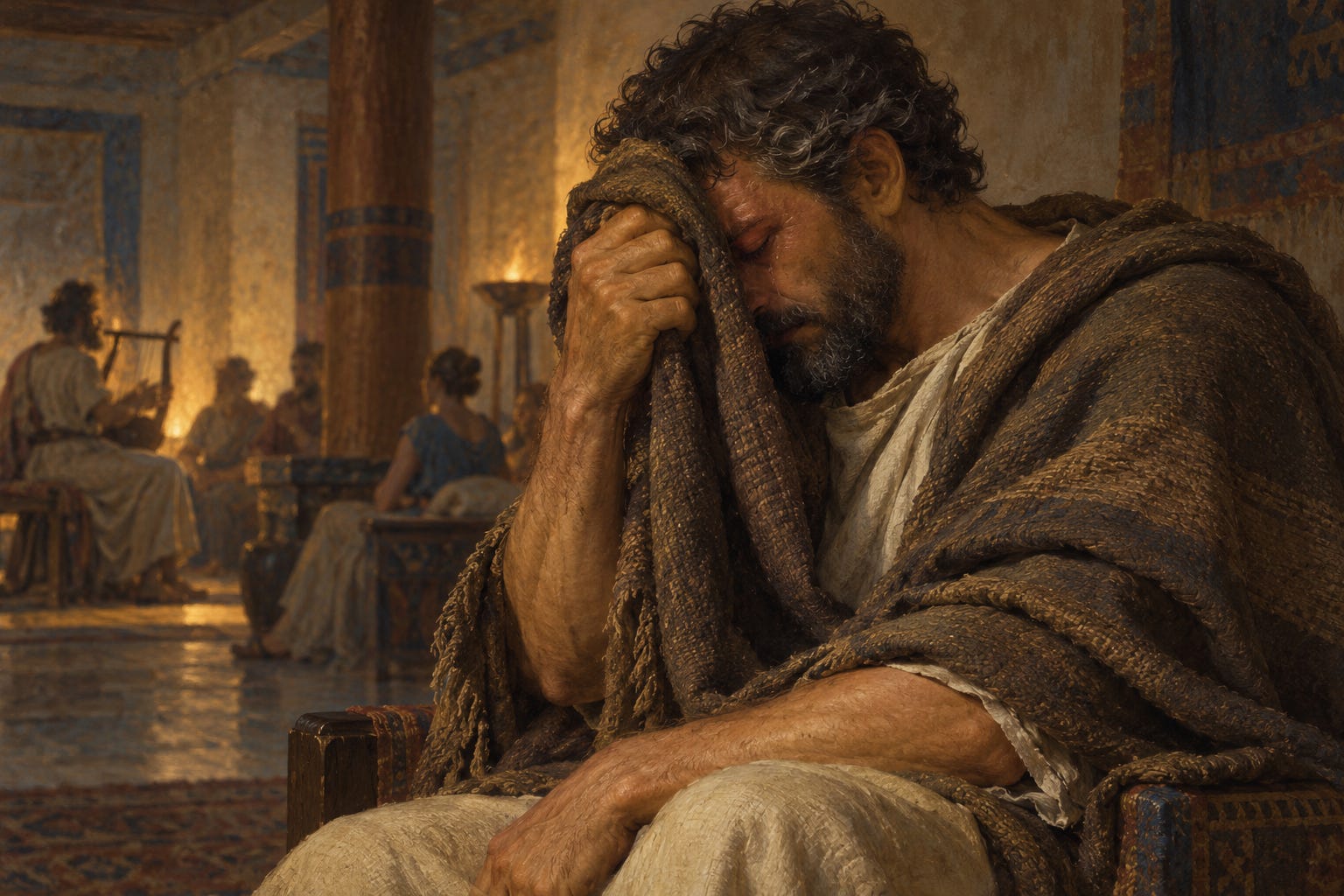
When the singer reaches the fall of Troy, Odysseus weeps again, and Homer reaches for an extraordinary comparison. He weeps, Homer says, as a woman weeps when she throws herself on the body of her husband, fallen defending his city and children. The greatest of the Greek heroes, likened to a grieving widow, and the poem thinks no less of him.[2]
Later readers did. When Alexander Pope translated the scene in 1726, he wrote that Odysseus “resign’d to soft affliction all his manly mind”, and wept “again unmann’d”.[2] Homer has shame in the passage. Pope added the idea that tears cost a man his manhood. The stiff upper lip was written into the translation, not the original.
That is a more useful picture of a man than the one we inherited. Odysseus is capable, dangerous, intelligent and homesick. His grief does not cancel the rest of him.
Two modern photographs make the point again. In 1940, Jerôme Barzetti was filmed in Marseille weeping as France’s historic regimental flags were paraded before being sent to safety after the Nazi invasion. The still became known as the “weeping Frenchman”. Fifty years later, Paul Gascoigne cried after a yellow card in England’s 1990 World Cup semi-final left him facing suspension from the final. The response was sympathy, then the familiar mockery. The Guardian places both images in a history of masculinity that still finds male tears oddly remarkable.[1]
That makes the silence of my father’s generation stranger, not simpler. Greek men arrived in Australia from a culture that knew public lament and had heroes who wept. Yet many learnt quickly that loss was not something to be spoken of. They had left villages, parents, siblings, language and certainty behind. The tears were not gone. The permission was.
Perhaps that was the bargain migrant men thought they had to make: be strong for the family, say little, keep moving. But the barrier this built did not only keep grief in. It kept the people closest to them at a distance as well.
Last week a Japanese diplomat leaving Athens after four years said goodbye in Greek, with lines from Cavafy’s “The God Abandons Antony”.[3] Cavafy, an Alexandrian Greek, drew the line our fathers were never offered. Antony is told not to mourn uselessly or pretend it was a dream, but to “go firmly to the window and listen with deep emotion, but not with the whining, the pleas of a coward.” [4] Feel the loss in full; just don’t beg. That is not the stiff upper lip. It is permission with a spine.
Odysseus wept. Barzetti wept. Gazza wept in front of millions. None of them became less human for it, or more manly. They were simply men who had lost something.
Sources
[1] https://www.theguardian.com/society/2026/oct/17/39-pictures-that-changed-the-way-we-see-men-for-good-and-for-bad — Muscles, metrosexuals and male tears: the 39 pictures that changed the way we see men
[2] https://beta.perseus.tufts.edu/urnctsgreekLittlg0012.tlg002.pope1726watson1858-eng2/book8 — Homer, Odyssey, Book 8 (this page carries Pope’s 1726 translation and others, including Samuel Butler’s prose version)
[3] https://greekcitytimes.com/2026/10/18/takaaki-nemoto-cavafy-farewell/ — Japanese Diplomat Takaaki Nemoto Farewells Greece With Cavafy Verse in Greek
[4] https://www.leonardcohenfiles.com/cavafy.html — The god abandons Antony by Constantine P. Cavafy (1863-1933) tr. Edmund Keeley and Philip Sherrard