

I was in the training room at the women’s facility, setting up workbooks and logging in the workstations, when I noticed one of the prisoners working her way through the Covid decontamination routine – wiping down the surfaces methodically, doing the job properly. She was young, perhaps early thirties, and there was nothing about her that matched the picture in my head. I made the kind of polite conversation you make when you’re sharing a space, and eventually asked whether she might be interested in doing one of the courses.
She gave me a wry smile.
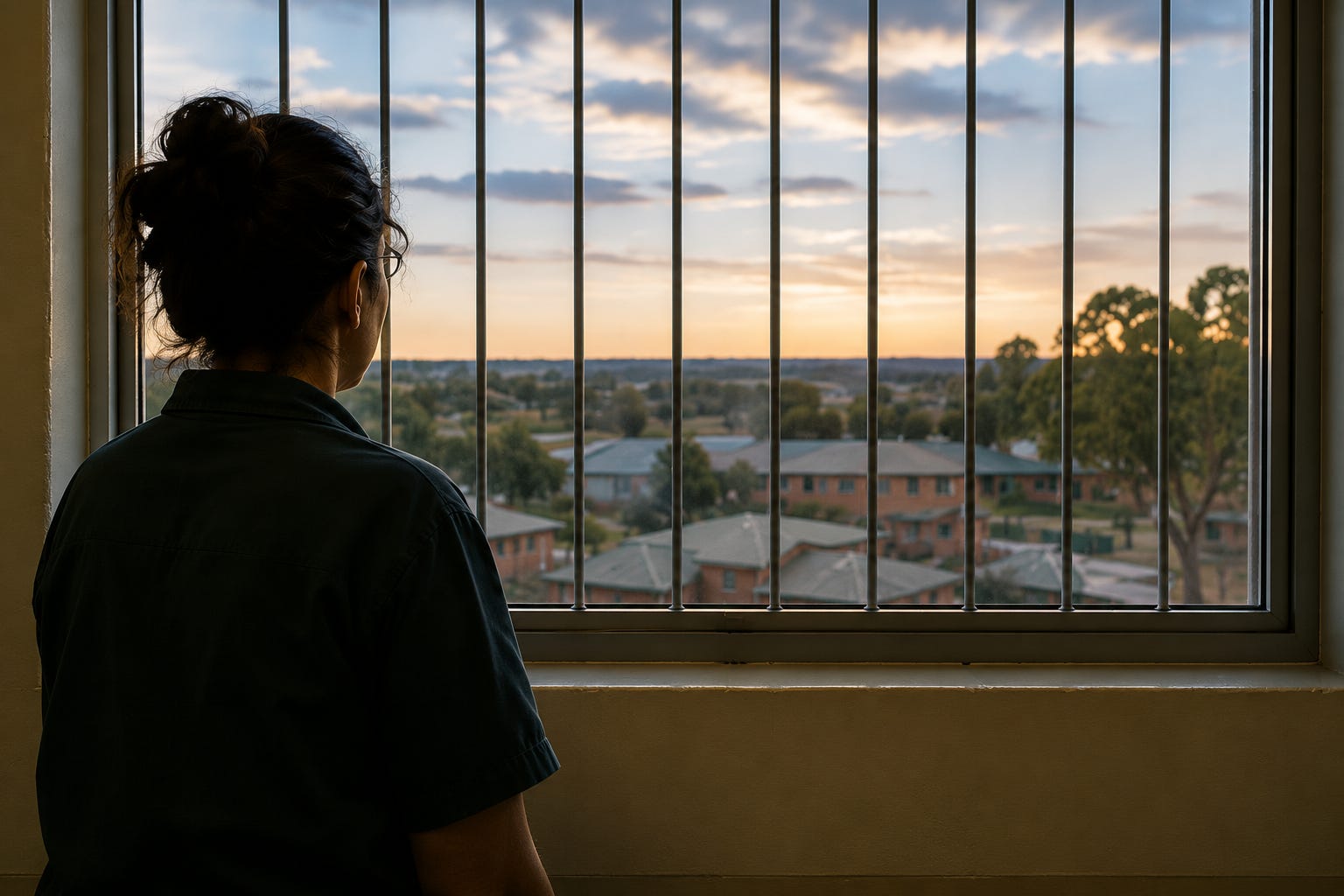
She didn’t qualify for the government-funded training, she said. She already had a Masters degree.
In Computer Science.
That was the moment I understood, for the first time, that I had arrived with assumptions I hadn’t known I was carrying.
I had spent more than forty years in software development and management, much of it teaching developers and users how systems worked. After retiring, I completed the formal training qualification I needed to teach casually. Then Covid hit Victoria, I found myself teaching Python remotely for a TAFE, and through that connection I was offered a short-term engagement in Victoria’s correctional facilities.
I had no prior exposure to the corrections system, despite my daughter working in it as a social worker. I went through the mandatory security training: what to look out for, what to avoid discussing, how to use the personal distress devices, what you could and couldn’t bring in. And then I started teaching.
A prison classroom bears almost no resemblance to any classroom I had taught in before. There is no “class” in any conventional sense. Sessions are scheduled; prisoners choose to enrol; if they pass a basic language, literacy and numeracy test, they’re eligible to attend. At any given session, the students in the room might be working on different parts of the syllabus, or toward different qualifications entirely. This is because prison schedules are not your own: a student might miss a session because of a legal meeting, a court appearance, or any number of conflicts they have no control over. You join when you can, work at your own pace, and the instructor moves around the room explaining concepts one on one as needed rather than presenting to a group.
The workbooks stayed with me between sessions. Files lived on the server. No flash drives allowed. Printing was controlled, vetted, handed over by me personally. When a student believed they had completed the requirements, they’d ask for an assessment. I would take the next couple of days to review it properly, because the outcome mattered: a nationally recognised qualification, bearing the name of a registered TAFE college, with nothing in it to indicate where it had been earned. That credential was the point of the exercise. It had to be legitimate. I made sure it was.
What I found inside the sessions was not what I had expected – partly because I hadn’t examined what I was expecting carefully enough.
The prisoners were not a uniform population. At one end there were people who had run afoul of the law for technical or relatively minor reasons, often on remand and not yet convicted of anything. At the other were people who had been in and out of the system since childhood, for whom the pattern was so established that a TAFE certificate was never going to alter its trajectory. Between those two ends were people who had made one catastrophic decision, people who had never been given much of a chance, and people who had been making the same mistake for years.
There were students using the sessions to pass time, or to sit at a workstation and produce digital drawings, or simply to be somewhere other than their cell. You could read it within minutes. They were not going to walk out and into an IT role, and we both knew it, and the pretence that the session was about training felt thin.
There were others who had qualifications exceeding what I was teaching – former professionals, often there for white-collar offences – who were ineligible for these courses because they were already overqualified. Some of them would have benefited from training at a higher level. Nothing was available to them.
And then there were the students I found myself spending real time with. Usually young. Often from backgrounds that had not given them many chances before this one. First-time offenders, in many cases, whose futures were not yet fixed. I would work through the material with them but also through what it actually meant: that a Certificate II was an entry point, not an arrival, that it got you to the room where the door was, not through it, but that the path forward from there was real and learnable. I left those sessions thinking: perhaps. Just perhaps.
The empty sessions were harder. A ninety-minute commute each way for a room where nobody showed up is a particular kind of dispiriting. You catch up on assessments, tidy the storeroom, and try not to do the arithmetic on how much public money the arrangement costs per hour of actual learning delivered.
The women’s facility added a dimension I hadn’t anticipated. Occasionally, in conversation, a student would mention something about domestic violence – not in a way that invited discussion, and we had been trained not to engage beyond the task at hand, both for our protection and theirs. But it surfaced in a way it never did in the male facilities, and I found I couldn’t quite set it aside afterwards.
The young woman with the Masters degree stayed with me too. She had everything she needed to have a different kind of life. Something had happened. And the thing the system was offering her – the thing it was offering everyone – was a Certificate II.
I don’t know how many of the students I taught are working in IT today. I don’t know the recidivism numbers. From what I could see, the program was not designed to find out. There were targets to meet, boxes to tick, a contract to fulfil. Whether any of it translated into changed lives was not, as far as I could tell, a question anyone was actively asking.
That is not a small thing to set aside. The students who deserved most from the program – the young ones, the first-timers, the ones not yet set in a pattern – were sharing a room with those for whom the program was never going to make any difference. The system did not distinguish between them.
I tried to.
Whether that was enough is the question I still can’t answer.