

Look up “dilettante” in almost any dictionary and you’ll find it isn’t a compliment. Merriam-Webster calls a dilettante “a person having a superficial interest in an art or a branch of knowledge”. Cambridge settles for someone whose understanding “is not very deep or serious”.
In a recent essay for Aeon, the philosopher Jay Miller sets out to rescue the word.[1] It wasn’t always an insult, he points out. The Baroque-era Italian dilettante was someone who pursued an interest, usually an artistic one, “for the sake of pleasure, or ‘delight’”. What Miller pushes back against is “the diffuse yet relentless pressure to narrow one’s interests, to specialise, to gain expertise, to forgo breadth for the sake of depth”. In that story, he writes “the specialist is the hero and the dilettante is but a cautionary tale”.
I read it with the uncomfortable feeling of a man recognising himself as the hero.
Depth
For about forty years I did exactly what that story recommends. I went deep into one field, and I don’t regret it. I loved the technical side of software development, and later I came to love the training, leadership and management side just as much.
But depth has a way of becoming a definition. “Software developer” stopped being something I did and became something I was. And even work you love brings work you don’t.
I won’t name names, but one example will stand for many. We were invited to bid for a major implementation. It wasn’t a perfect match for our main software package, but it was close enough to be a sensible base, and the only real alternative was a bespoke system built from scratch. The customer was literally on the other side of the country. We flew there three or four times, at real cost in money, time and inconvenience. Eventually we worked out that we had never really been in the running. We had been invited so the customer could wave a cheaper alternative at a large consultancy and get a better price on the bespoke job.
Tenders, pre-sales meetings and proposals were part of the price of a career. The energy for them had to come from somewhere, and it came from everything else.
The things that fell away
As a teenager I was, without knowing the word, something of a dilettante. I danced with a Greek dance team through most of the 1970s. I learnt keyboard for a while, and later taught myself guitar to a very amateur standard. The dancing was a youth thing, and the functions we performed at petered out. The guitar went quietly, as the career took more of my time.
Writing went the same way, or nearly. I always wanted to write. In the mid-1990s I had a personal website on a wiki, which was hacked because I wasn’t paying attention. Later I hosted a WordPress blog myself at jimako.com, and a few of those posts survived the hacks that followed.[2] I would write an article or two, then go literally years without writing another.
The one place writing did survive was inside the job. As a development manager at a private software company, I wrote technical articles for the magazine we published for our customers, the Australian Visual Developers Forum, on advanced and unusual ways to use Visual Basic. It was one of the parts of the job I enjoyed most. It gave me an excuse to dig into the inner workings of both VB and Windows. Looking back, it was the only writing I had permission to do, because it counted as work.
Permission
I’ve written before about why I left full-time work at the end of 2017. What I didn’t expect was that leaving the job would not, by itself, free me to do other things.
It took a few years of retirement before I was comfortable that being a programmer was not the definition of who I am, or of what I’m able to do. Only then did the writing come. In 2025 and 2026 I wrote two books at the same time: Code is Design, about software, and The Long Road Down, a shorter book about living with diabetes for thirty years and how differently it was treated then. And I started this blog, which has now run longer than any of my earlier attempts.
The moment I noticed the change was small. Flying home from Greece in late September, I was filling in the Australian incoming passenger card. It asks for your usual occupation. I was about to write “retired”, which is accurate. Instead, rather cheekily, I wrote “author”.
Where I part company with Miller
Miller’s dilettante is a lifelong state, a “perpetual movement from one thing to another”. I’m not sure I could have lived that way, or that I would have wanted to. The forty years of depth are not something I need to apologise for. They’re the reason anyone might want to read what I write about software and AI now.
So my story has a different shape: depth first, then delight. And I suspect the order matters. Some of what I can now enjoy as an amateur, I can enjoy because I spent a career as a professional.
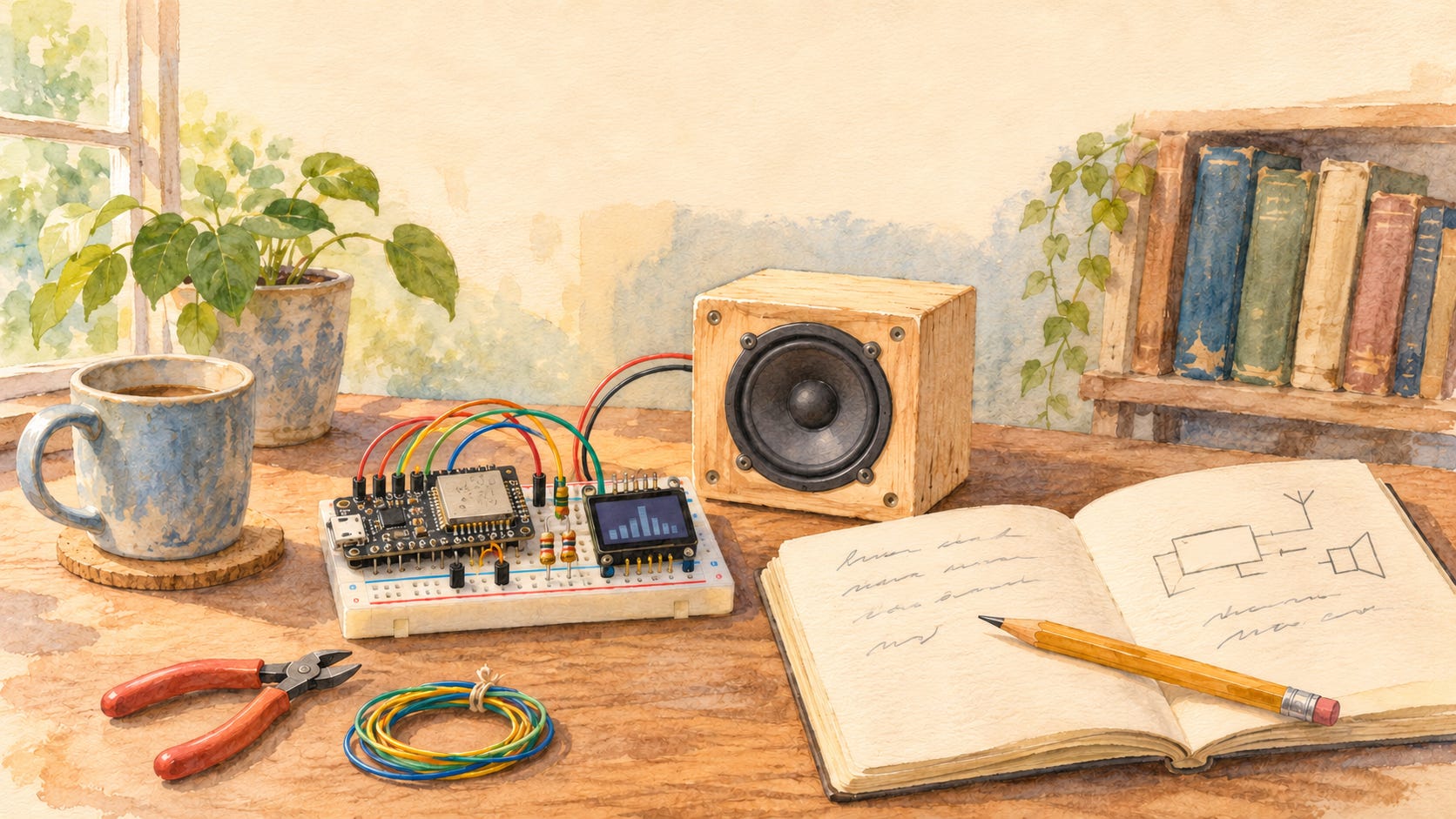
These days I’m dabbling in electronics. I wire up components on breadboards, solder things I probably shouldn’t, and write the software that makes them work. At the moment I’m building an internet radio around a small microcontroller called an ESP32. I’m not especially good at the hardware half, and I don’t need to be. That’s the point.
I still put on the expert’s hat when someone asks. But it’s now one of the things I do, not the thing I am.
If I have one regret, it’s that it took retirement to give me that permission. The question I’d put to anyone still deep in a career is simple: what is the thing you put down when your work became your name, and does it really have to wait?
I don’t think I’ve become a dilettante. But for the first time in decades, I’m doing some things purely because they delight me, and I’ve stopped apologising for it.
[1] Jay Miller, “Why the dilettante is the anti-hero of our over-optimised age”, Aeon, 30 October 2026.
[2] Jim Karabatsos, surviving posts, jimako.com.