

“We feel like we’re doomed anyway so why should we save?”
That’s An Tran, a 21-year-old Sydney law student, in a Guardian piece about young people spending on small pleasures because the big milestones feel out of reach.[1] The piece does the arithmetic: an $8 matcha five days a week for 48 weeks comes to $1,920 a year, against a median capital-city house price of $1,103,201.[1]
I hear that attitude from many of the young people I know, perhaps most of them. And I’m sympathetic. Unless they can get help from their parents, buying a home can look close to impossible. Being told to give up the avocado on toast, or the $8 matcha, is frankly offensive when you compare their incomes with what housing costs. I made that comparison in “Too Young for Woodstock, Too Old for Gen X”[2]: in 1980 I bought my first house for about 4.85 times my salary, and the same job today would need about 35 times its salary to buy that house.
So let me be clear before I go any further. Housing in our capital cities is far more expensive, relative to wages, than it was forty years ago. Not everyone can buy a home by saving hard, and that has always been true. There are many people who simply aren’t in a position to buy, whether because of their work, their health or their family situation.
But there is another side to this, and I think it’s worth saying.
The house they want
What I notice is that many young people want, as their first home, the same home their parents have after working for forty years. Not just the size and type of house, but the location.
The locations have changed, though. When Maria and I bought our first home together in late 1987, it was a flat in Brunswick. Brunswick is a hip suburb now; then it was a cheap place to live. We paid $77,000.
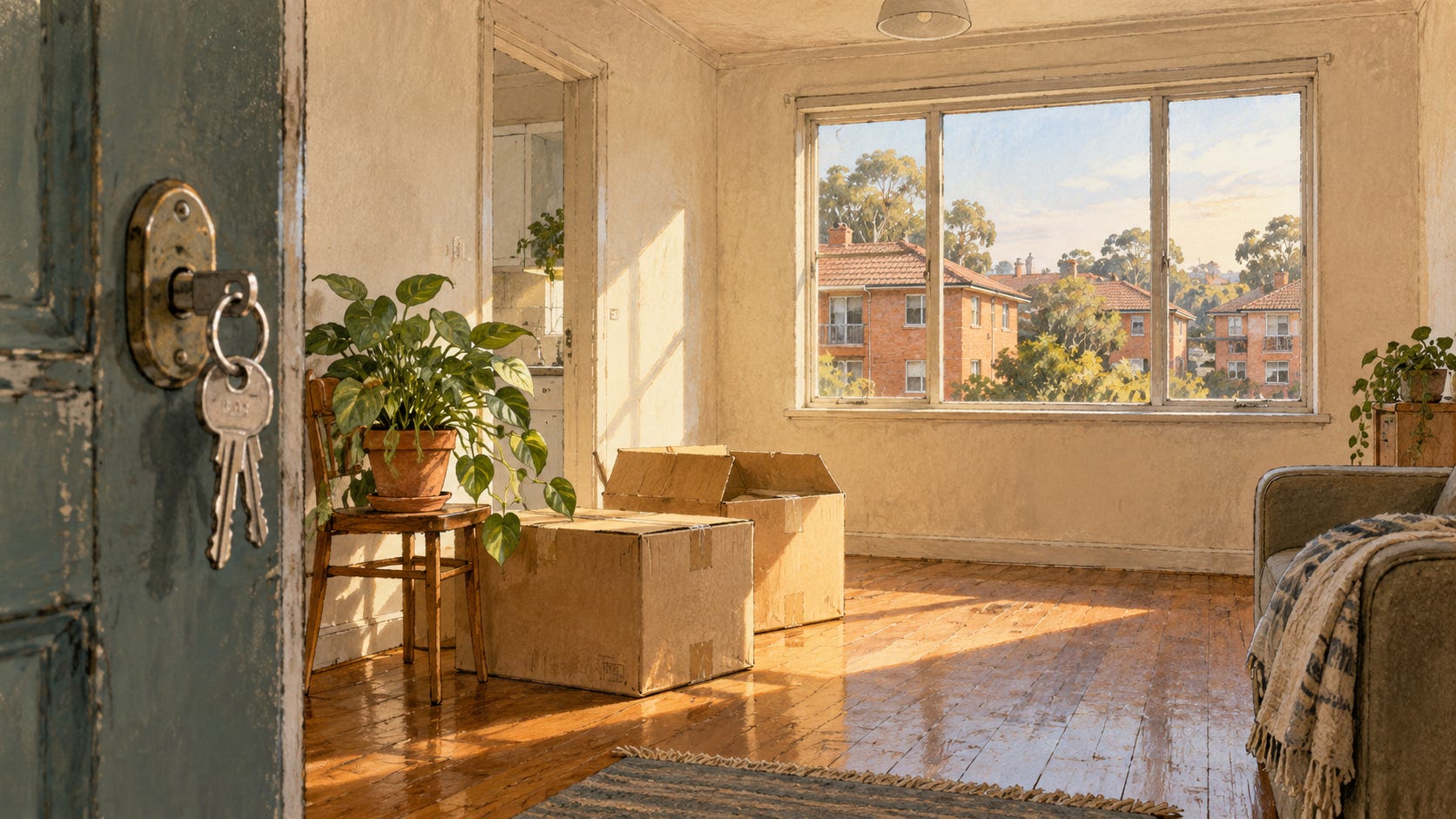
Both sets of our parents had lovely large period homes, one in Northcote and one in Middle Park, in suburbs that were and still are considered very desirable. The twist is that when they bought them, in the mid-1960s and the mid-1970s, those suburbs were cheap, working-class places. The gentrification came later, over decades. Our parents didn’t buy into desirable suburbs. They bought into suburbs that became desirable while they were living in them.
How Maria did it
Maria was a bank officer, earning roughly $24,000 a year, about $15,000 after tax. As was expected in the Greek community then, she lived with her parents until she married. Over about six years of work she had saved roughly half the price of that flat.
I encouraged her to buy it in her own name, and I helped her organise the finance. I did that because I was furious. The first bank she went to, where she had banked all her life, would not lend her the money unless I was on the contract. She had half the purchase price in cash, and she was given a hard time simply because she was a woman. That was never the reason stated, but it was the only explanation – she had a long-term, steady and secure job, a demonstrated ability to save, and a 50% loan to valuation ratio. The Sex Discrimination Act 1984 had made this illegal, but it was still the reality many women faced at that time.
So the flat cost about 3.2 times her gross salary. I can’t find a recent price for that exact flat, but a two-bedroom apartment on Sydney Road in Brunswick, one less bedroom but with a much higher spec than ours, recently sold for $580,000. Against today’s average full-time salary of about $108,000,[3] that’s around 5.4 times. Harder, without question. But not 35 times.
Some back-of-the-envelope arithmetic
Suppose you want a three-bedroom house in an average Melbourne suburb. Realistically that’s at least $1 million. You need a 20% deposit ($200,000) plus stamp duty, which at that price is about $55,000. Call it $255,000, before conveyancing, loan fees, and pest and building inspections.
Saving that is a very hard target, and often an impossible one. A couple, both on average full-time wages, would take home something like $165,000 a year between them after tax. If they’re careful, even while renting a small place, they might save half of that. That means no holidays for a while, no concerts or bars, no name-brand clothes. It’s a real sacrifice. But saving a deposit has always been hard, and on those numbers they could get there in about four years, allowing for prices rising in the meantime.
Notice what that assumes: a couple, both earning at least average wages. Not one person, and not minimum wage. I’m not suggesting that if everyone just buckled down they could all buy a house.
A different first rung
But maybe a median-priced house isn’t the right goal for someone starting out. It wasn’t possible forty years ago without similar circumstances and similar sacrifices either.
The median one-bedroom apartment in inner-city Melbourne is valued at about $386,000.[4] A first home buyer in Victoria pays no stamp duty below $600,000.[5] Under the federal 5% Deposit Scheme, a first home buyer can borrow with a 5% deposit and no lenders mortgage insurance, up to a price cap of $950,000 in Melbourne.[6] That’s a deposit of under $20,000.
Suddenly the equation looks very different. One person on an average take-home wage can save that in a reasonable time, especially if they’re lucky enough to be able to live with their parents for a year or two (and willing to). Maria did exactly that.
Is it ideal? No. Is it the forever home their parents have after forty years of work? Obviously not. But first homes have never been that for most people. You get into the market however you can, then climb the ladder. You sell and upsize, or you keep the small place and rent it out as you move on.
I should be honest about the risk in that last step, because a careful reader will raise it. The ladder depends on the first rung going up in value, and small inner-city apartments haven’t always done that. Inner-city Melbourne apartment values are still below their December 2021 peak.[4] A first apartment is a way into the market, not a guaranteed investment.
What I’m not saying
I’m not saying young people have it easy, or that the people who can’t buy just aren’t trying. The gap between wages and house prices is real, and it isn’t their fault.
What I am saying is that “doomed” sets the bar at the house their parents ended up with, not the one they started with. Our parents’ first homes were in suburbs nobody wanted. Ours was a flat in a suburb nobody wanted. The first rung has always been lower, smaller and less glamorous than the one you’d like. It’s still there.
[1] Catie McLeod, “’We’re doomed anyway’: young people disheartened about the future are splashing out on the present”, the Guardian, 1 November 2026.
[2] Jim Karabatsos, “Too Young for Woodstock, Too Old for Gen X”, Ground Truth, September 2026.
[3] Australian Bureau of Statistics, “Average Weekly Earnings, Australia, May 2026”: full-time adult ordinary time earnings $2,083.70 a week.
[4] Urban Property Australia, “Q1 2026 – Melbourne Apartment Market”.
[5] State Revenue Office Victoria, “Help to buy a property”.
[6] Mozo, “Australian Government 5% Deposit Scheme” (price caps from 1 October 2025).
You have to look at the psychology of the time of when our parents came as migrants and just wanted to own their own home and build a family. For them it was about survival, not 'lifestyle'. It would be very hard for a young couple today to live the way out parents lived, or even they way we did in the early years in order to build a life. As for the first rung, I totally agree. I would rather be paying off my own little flat somewhere in a not so desirable area than paying rent in a trendy one. My parents would always say that while you are working renting is fine, but when you are no longer able to work you could end up in very undesirable circumstances and that has always stayed with me.