

When I was discharged from hospital after my diabetes diagnosis in 1994, I came home with a plan. I am the kind of person who responds well to structure and plans – always have been – and the plan was clear. My wife would cook according to it. I would count the servings, eat on schedule, inject my insulin four times a day, and monitor my blood glucose readings carefully. I would do exactly what I had been told.
Over the following two to three years, I gained 38 kilograms.
Not because I abandoned the plan. Because I followed it.
To understand how this is possible, you need to understand the food pyramid. This was a nutritional guidance model adopted by governments and health authorities around the world from the early 1990s – a simple visual diagram, ranking food groups by their recommended daily proportions. At the base, the foundation of a healthy diet, the thing you were supposed to eat the most of: grains and carbohydrates. Bread, cereal, rice, pasta. Six to eleven servings a day was the official recommendation. Above that, fruits and vegetables. Higher still, in smaller quantities, dairy and protein. And at the very apex, the smallest sliver: fats, oils, and sweets. To be used sparingly.
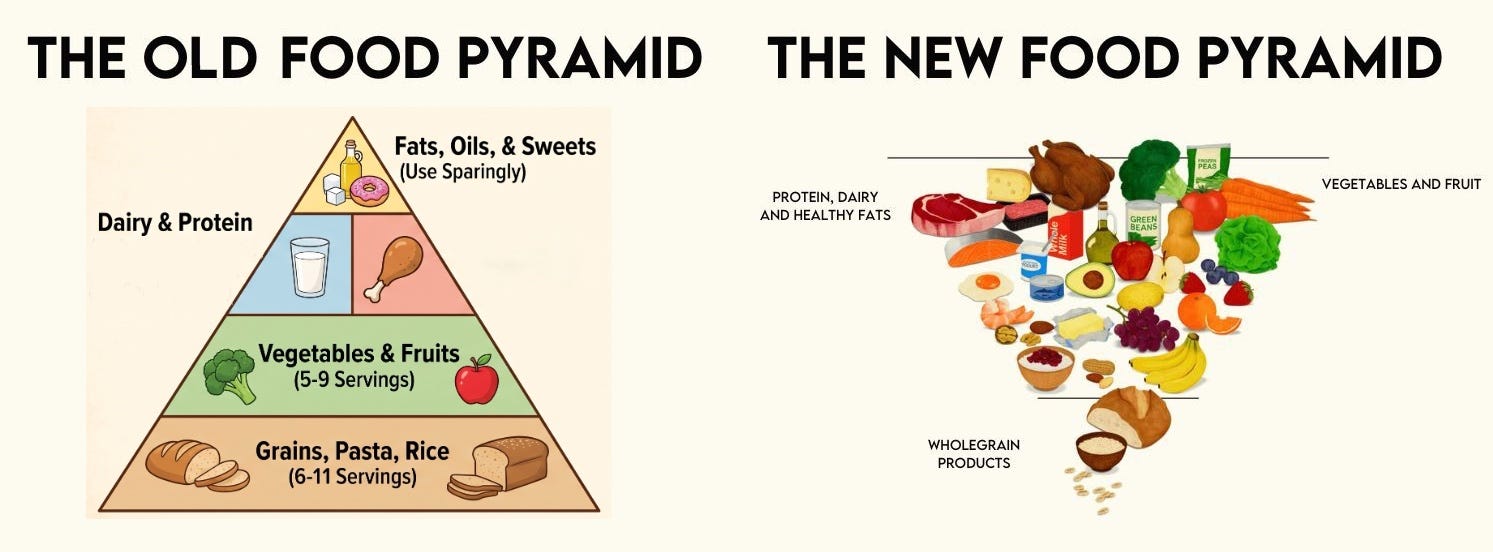
Now consider what that means for someone with Type 2 diabetes.
Every carbohydrate converts to blood sugar as the body processes it. Bread. Pasta. Rice. Cereal. For someone whose body already cannot manage blood sugar efficiently, loading every meal with the foods that spike it fastest is the dietary equivalent of telling a person with a broken leg to go for a run. And when the blood glucose dipped – as it inevitably did, because that is what insulin does – the advice was to eat more carbohydrates to compensate. If I was planning more exercise than usual, eat more carbohydrates beforehand. The answer to everything, in the dietary orthodoxy of the time, was more carbohydrates.
My body did exactly what bodies do when they are fed a steady supply of glucose with adequate insulin to process it. It stored the excess as fat. I ate according to the plan. I injected my insulin. I bought the pasta and the bread and the rice and I cooked it according to the prescribed proportions. I tried Jenny Craig. I tried pre-portioned meal delivery services. I lost some weight, then stopped losing it, then put it back on and then some. By the end of those years, I weighed 158 kilograms. I had been 120 kilograms on the day I left hospital.
I want to be precise about what 158 kilograms means in practice, because the number alone doesn’t capture it. It means that cinema seats and aeroplane seats require a strategy. It means that stairs become a calculation. It means that a photograph, when you encounter one unexpectedly, produces a moment of genuine shock – because the image doesn’t match the person you carry in your head. It means that your body is always present, always asserting itself, always requiring management in ways that people who have not carried that weight cannot fully intuit.
I am not telling this story to assign blame. The medical profession is not full of fools, and I want to be clear about that. The dietician who worked with me was doing her job conscientiously and in good faith. The dietary advice I received was the standard advice of its time, endorsed by governments, taught in medical schools, and believed by the professionals delivering it. The problem was not the individuals. The problem was the orthodoxy they had been trained in – and the fact that it was wrong.
We know considerably more now. The evidence accumulated over the past three decades points firmly in a different direction. Protein should form the foundation of the diet. Healthy fats are not the enemy – many are actively beneficial. Carbohydrates should be present but chosen carefully and consumed in moderation, not as the centrepiece of every meal. For someone with Type 2 diabetes specifically, reducing the foods that spike blood glucose is not optional. It is the central dietary principle. The food pyramid had it precisely backwards.
This is not fringe thinking. It is backed by substantial research and has been progressively incorporated into updated guidelines around the world. The original food pyramid has been revised, replaced, and in some jurisdictions quietly retired – as though it simply aged out, rather than did damage on its way out.
That damage is what I want to name clearly, because I don’t think it has been named clearly enough. The people who followed the food pyramid in good faith – diabetics, overweight people, anyone who trusted that their government and their doctors had got the nutritional science right – were following advice that was making them worse. Some of them paid for that with their health. Some of them paid for it with their lives. The fact that the advice was given in good faith does not change the outcome for the people who received it.
When official guidance turns out to be wrong, the institutions that issued it tend to move quietly to the next position. The updated pyramid appears. The new plate model replaces the old one. The guidelines are revised. And the people who spent years doing exactly what they were told are left to work out, largely on their own, what that means for the damage already done.
There is no apology. There is rarely even an acknowledgement.
That is not where you want to be. I know, because I was there.
I write about my own experience managing Type 2 diabetes — thirty-plus years of it. None of this is medical advice. Your situation is not my situation, and nothing here should be a reason to change your diet or treatment without talking to your doctor first.
If you enjoyed this, or any of my posts, I would ask you please to react here on Substack, with a comment or a like. It is the only way the algorithm will make the post visible to people who have not subscribed to the newsletter but who may be interested in (and hopefully helped by) the articles.