

On certain nights in the late 1960s, my sister and I would leave Greek school at speed.
Not because we were escaping some terrible punishment, although there were nights when the prospect of another dictation exercise in Katharevousa made that seem a reasonable option. We were running home because Star Trek was on at seven o’clock.
The school finished just before then. Home was about five minutes away if we ran flat out. We did.
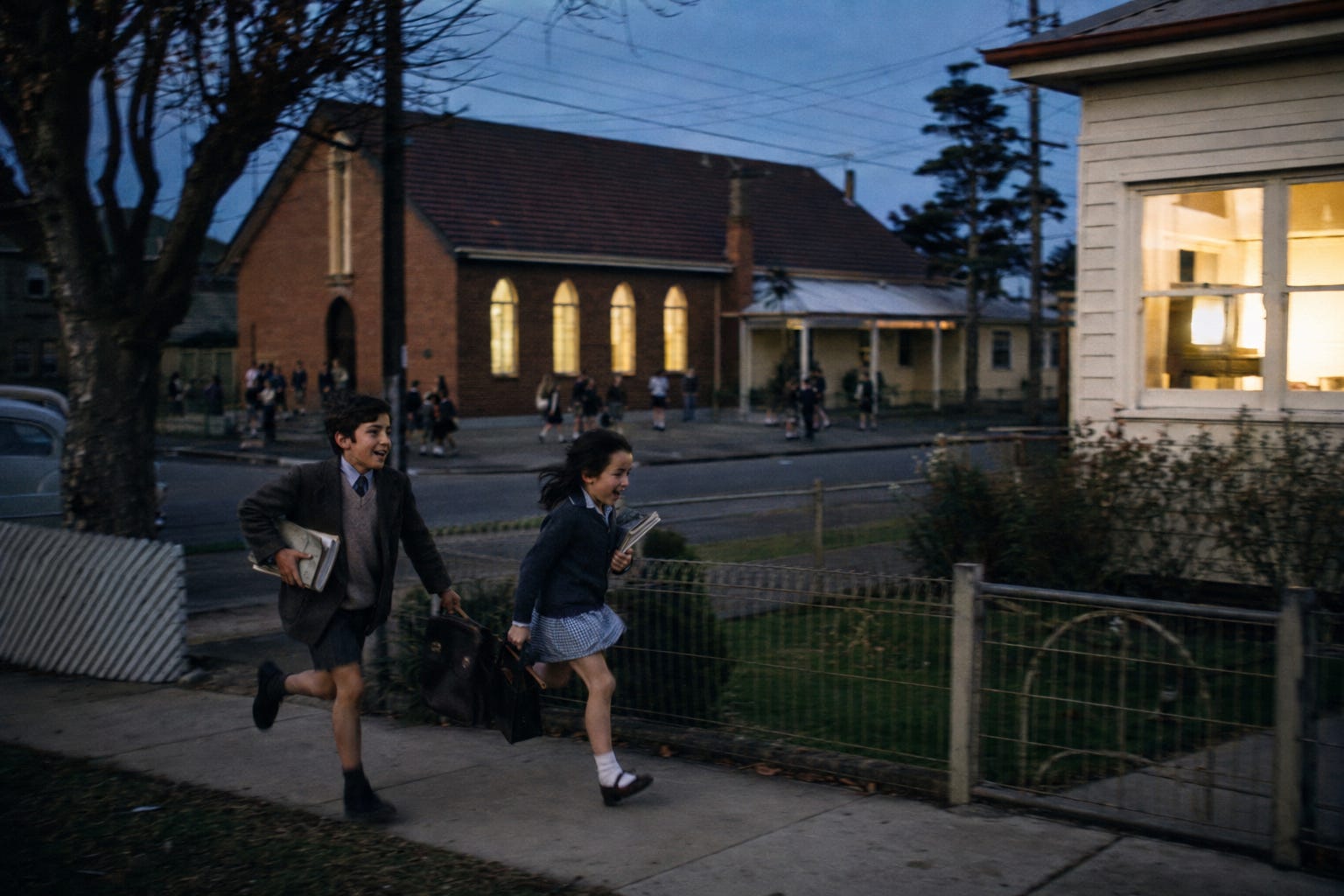
This was long before catch-up television, streaming services or even a VCR in the house. If Captain Kirk was due to encounter some suspiciously humanoid alien, you either got home by seven or you missed it. That was the whole technology stack.
The Greek school itself was literally across the road from my Australian day school, Middle Park Primary. It had been founded by the Greek Orthodox Archdiocese in South Melbourne and began when I was in Grade 2, in 1966.
It occupied an old, disused Protestant church building. We sat in what were essentially converted pews, balancing our exercise books on the back of the pew in front of us. There was one teacher for the entire school. The classes were combined: junior students attended on two evenings a week, senior students on two others. Some years there was a shorter Friday session for religious instruction, rather like what would now be called Sunday school.
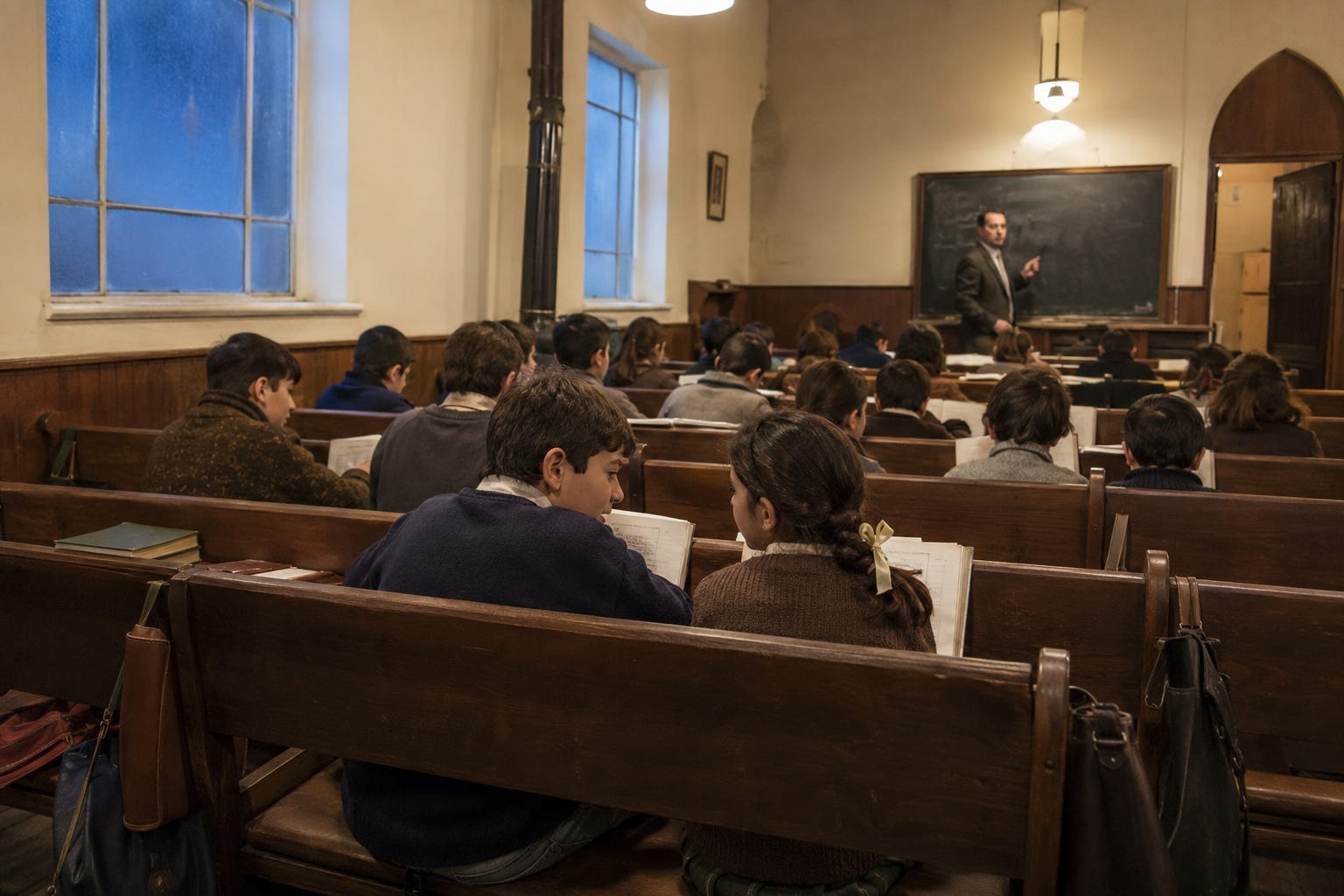
It was not a grand institution. It did not have rows of classrooms, specialist teachers, computers, language laboratories or glossy brochures about bilingual advantage. It had one teacher, old pews, books sent from Greece, a community that made do, and parents who were absolutely determined that their children would get an education.
That last part mattered.
The school started after I had already begun at Middle Park Primary, which meant I was always one year behind my Australian school grade in Greek school. My sister was two and a half years younger than me, and very bright. She took exception to the arrangement. It was unfair, she decided, that I was going to Greek school and she was not.
She made enough of a fuss that my parents enrolled her too.
So I was one year behind my Australian school year in Greek school, while she was one year ahead of hers. It was not the first time, nor the last, that my sister found an efficient way to improve her position.
The books came from the Greek government through the church. There were readers suited to each grade, along with books on grammar, history, geography and other subjects. Every week we had homework. We would copy a passage into our workbooks to improve our handwriting, then learn the spelling of a shorter piece for dictation at the next class.
None of that sounds especially remarkable now. But the Greek we were learning was not the Greek most people hear in Greece today.
This was the era of Καθαρεύουσα – Katharevousa – the formal written language that tried to bridge ancient Greek and the vernacular. To a schoolchild, it felt less like a bridge than an obstacle course.
There were breathing marks and several forms of accent. You had to know which mark belonged where, which syllable was stressed, and how the form of a noun or adjective altered the rule. Some of those distinctions no longer represented a difference in pronunciation, but they still mattered in the classroom. Get them wrong and you had not merely made a spelling error. You had shown that you did not understand the grammar.
It was demanding. At times it was ridiculous. Looking back, I can see why the later move toward modern Greek, with its simpler spelling system and the disappearance of the old breathing marks, made the language far more accessible.
At the time, though, it was simply work.
And it was extra work.
While other children had finished school for the day, we had another set of books, more writing, more reading and two or three evenings a week in a converted church across the road. By the time I had finished Greek primary school, I had had enough.
I begged my parents to let me stop.
They would not have a bar of it.
If there was one thing the first generation of Greek migrants took seriously, it was education. They may not have had much formal education themselves. They may have come from villages, arrived with limited English, worked long hours and lived carefully because money could not be wasted. But they understood education as something nobody could take away from their children.
Greek school was not presented as a pleasant optional cultural activity. It was part of being properly educated.
At the time, I did not appreciate the distinction.
I wanted my evenings back. I wanted less homework. I wanted to do what other children did, which was apparently everything except sit in a pew learning the correct accents for words they might never use.
My parents held their ground.
Later, when I began studying more science-based subjects at Australian school, I started to understand what they had given me. Greek school had not just taught me Greek. It had taught me how language worked.
When you spend years asking why a noun changes form, why a verb has to agree in a particular way, why an accent falls on one syllable rather than another, grammar stops being a vague collection of rules handed down by teachers. It becomes a system. You begin to see structure.
That helped with English as much as Greek.
I have never had much trouble knowing whether a sentence requires “I” or “me”, “we” or “us”. I do not say that as a claim to moral superiority, although I will admit to a small internal wince when the distinction is mangled. The point is that bilingual education made me pay attention to language at a level many of my peers never had to.
It also made writing easier.
By Year 12 at Australian school, I took Modern Greek as a subject. It was an obvious choice: I knew the language well, had years of formal study behind me and could see that it gave me an advantage.
At the same time, I was still a year behind at Greek school. I could easily have stopped. I was doing Year 12 Modern Greek in Australian school; why bother continuing with Year 11 in the evening program?
Instead, I wanted to do everything at the advanced level available at Greek school. I completed Year 11 there alongside Year 12 at Australian school, then went on to Year 12 Greek school while I was in my first year at university.
That is a long way from begging my parents to let me stop.
What had changed was not merely my attitude toward homework. I had begun to see Greek school as something more than language lessons. It gave me grammar, certainly, but also history, civics and a connection to a culture that was not limited to food, weddings and the sort of nostalgia people are happy to admire once it no longer demands anything of them.
It gave me another way to think.
Today, I do not translate between English and Greek in my head. I think in both languages. If I am speaking or writing English, my internal dialogue is English. If I am speaking Greek, or reading Greek, or in Greece, I think in Greek.
I even dream in both.
That distinction is visible in my own children.
All three went through twelve years of Greek school. All three can speak, read and write Greek. They do not have quite the same fluency as their parents – they were immersed in English from much earlier than my sister and I were – but they have more than enough Greek to communicate, to read, and to understand the cultural undertones that do not survive a literal translation.
They know when a word carries more than its dictionary definition. They can hear the difference between affection and obligation, humour and insult, formality and warmth. They understand the world behind the words.
And, I am pleased to report, every one of them knows when to use “I” and when to use “me”.
Coming to Greece each year for the past decade – apart from the COVID years – has strengthened that further. Language is not something you finish learning at eighteen and place on a shelf. It changes with use, place, conversation and time. My Greek now includes words and rhythms I did not grow up with. But it still rests on the foundations laid in that old church building across the road from Middle Park Primary.
The Greek school was inconvenient. It was demanding. Its curriculum could be punishingly formal. Its furniture was not designed with the comfort of children in mind.
But it was built by people who understood something we did not.
They knew that children would eventually be grateful for an education they were too young to value.