

In 1955, my father stepped off a ship in Melbourne with a third-grade education, no English, and no particular plan except that the conditions in this country could not possibly be as bad as those in the one he was leaving.
He had grown up in a farming village in southern Greece. His family was considered, by the standards of the village, reasonably well-off – and yet still couldn’t afford shoes for the children. He was pulled out of school at around eight or nine to help with the crops and tend the sheep. He later joined the police force, which tells you something about the options available to an ambitious young man in post-war rural Greece. He came to Australia in 1955. A few years later, he sponsored his sister to join him. His youngest brother left to join the Greek police force, which left two brothers to split the family’s farming land between them. If the family had stayed intact on the same plot, they could not have survived.
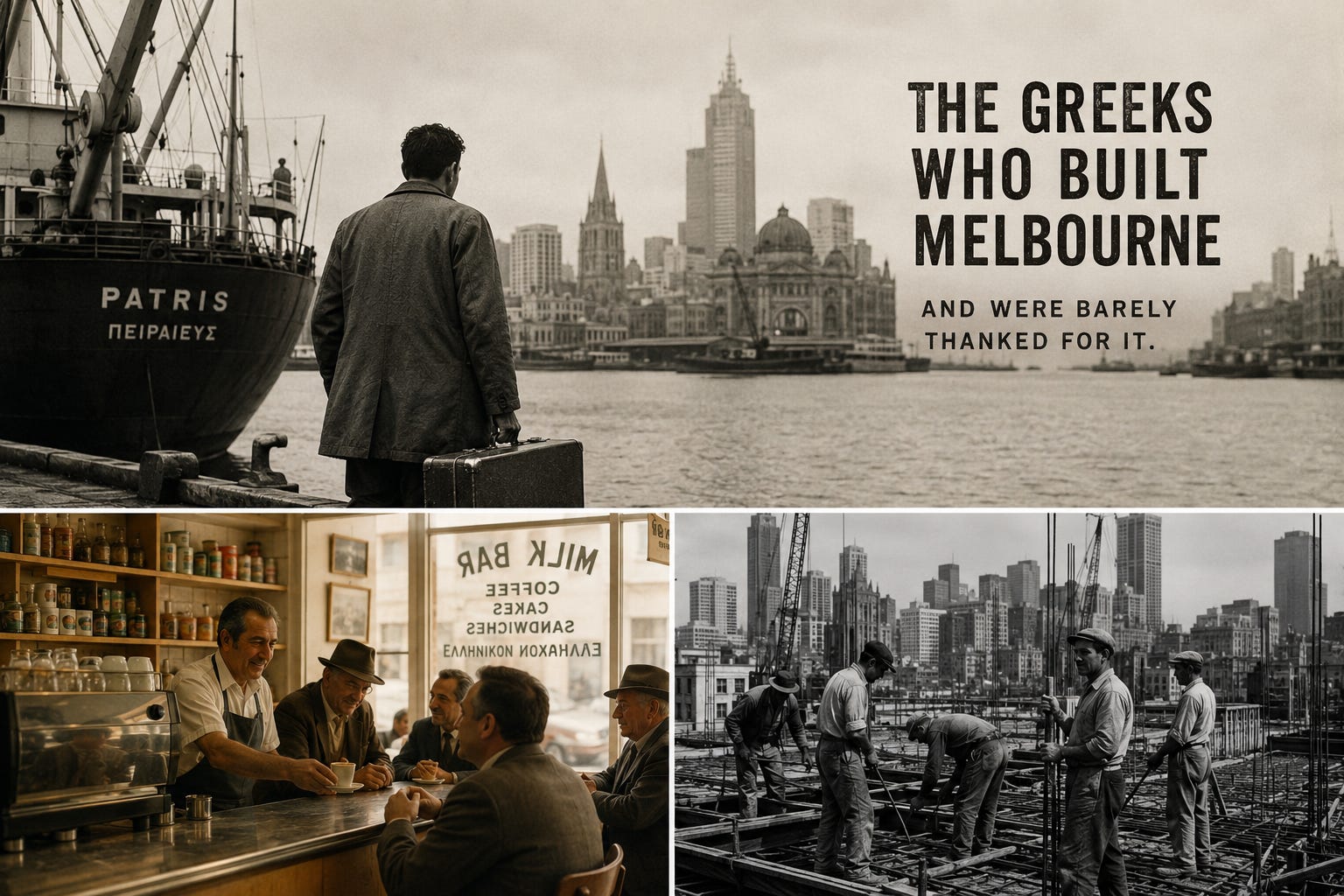
What Greece had been through in the decade before he left is difficult to overstate. The Nazi occupation had systematically stripped the country bare. More than one in ten Greeks died from the fighting, starvation, disease, and exposure. A civil war followed, fuelled by the power vacuum left by the occupation and the proxy struggle between East and West. By the early 1950s, people were not choosing between good options. They were choosing between bad ones.
We would call them economic refugees now. We would probably argue about whether they deserved to be let in.
What tends to get lost in these arguments is what emigration actually does. When a country loses people to migration, it does not lose them randomly. It loses the ones most willing to take a risk, most inclined to make a hard choice and bet on themselves. The country they leave is poorer for it. The country that receives them gets that energy instead. The Greeks who arrived in Australia in the 1950s and ‘60s were not the passive or the defeated. They were the ones who looked at what was in front of them and got on a boat for a month-long voyage to the other side of the world.
Australia needed exactly those people. The post-war economy was industrialising rapidly, and there was more work than there were workers prepared to do it. The Anglo-Saxon migrants who formed Australia’s existing labour pool did not, in general, want to work the cane fields of Queensland or stand at a factory production line for ten hours a day. The Greeks did. They poured molten steel to cast engine blocks. They sewed garments, either in home setups running late into the night or in what were, let’s be honest, sweatshops. They worked the vineyards, the building sites, the vegetable gardens that substituted for the villages they had left behind.
The official justification for relaxing the White Australia policy to admit them was, and I am not embellishing this, that southern Europeans were “almost white.” That is literally how it was discussed at the time. I include it not for shock value but because it tells you exactly what kind of welcome awaited them.
They were not, in any meaningful sense, welcome. They were tolerated. There is a difference.
A man who had spent the day pouring molten metal at the foundry was expected to go home, change into a suit, and attend English language classes in the evening so that he could integrate into a society that had no intention of promoting him out of the foundry regardless of how good his English became. The expectation was assimilation, not integration. Stop being what you are. Become something else. Do it quickly and without making a fuss about it.
Their children – children like me – were pressed into service as interpreters whenever their parents needed to deal with a government office, a doctor, a pharmacist. We were not supposed to speak our own language on public transport. The jobs available to our parents were, by design, the ones nobody else wanted. This is not a revisionist account. This is what it was. The popular narrative today treats multicultural Australia as if it had more or less always been there. It is a polished version of the story, and it does not match the memory of anyone who lived on the other side of it.
What they built, despite all of this, is visible everywhere you look in Melbourne.
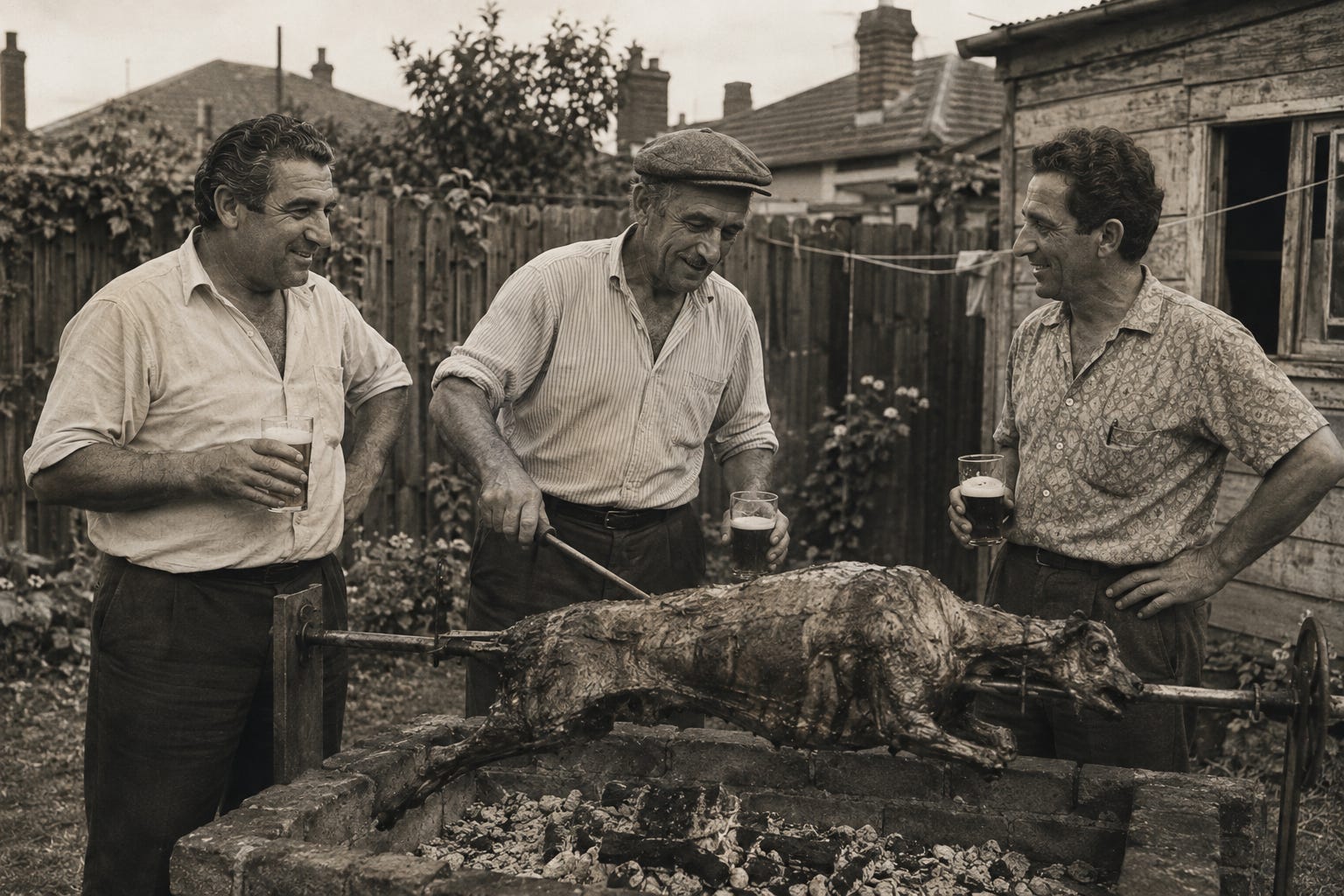
My father used to tell me about bringing a whole lamb home from the market on the tram – to the considerable entertainment of the other passengers – and setting up a spit in the back yard. The smell would carry over the fence, and the neighbours would drift over, because that is simply what you do when food is ready and people are nearby. Filotimo – the Greek obligation of hospitality that needs no invitation and requires no explanation – meant they were always welcome. The neighbours were often surprised to find themselves eating the best meal they’d had in months. They were sometimes unsure how to reciprocate, because the instinct that had drawn them to the table has no real equivalent in Anglo-Saxon culture. But they kept coming back. And they told other people.
Over the following decades, that dynamic played out at a city scale. Greek migrants, alongside other southern Europeans, built the hospitality culture that Melbourne now exports as a point of identity. The coffee that is still, by most accounts, the best in the country. The souvlaki, the spanakopita, the fish-and-chip shops and milk bars and modest working-class restaurants that became, over a generation, the foundation for something genuinely remarkable. They also drove the city’s property markets, took on the small businesses the established community didn’t want to bother with, and invested – often without formal training, succeeding through stubbornness and persistence – in the suburbs that now form the backbone of the city.
The Lonsdale Street of the 1970s – the Greek precinct, the kafeneions and cake shops – was almost exclusively Greek in its patronage. Walk into a Greek taverna in Oakleigh today and you will find Greeks, yes, but also Indian families, Asian couples, Anglo retirees, and every combination in between. All of them eating the food that someone’s yiayia was cooking in a back yard in 1958, while the neighbours watched with a mixture of curiosity and mild suspicion from the other side of the fence. That is what successful cultural contribution looks like, played out over sixty years.
It is worth saying, briefly, that this argument has contemporary relevance. The uncomfortable part is that the argument has not really changed. Only the names have. When the discussion turns to immigration and the housing crisis, one thing that rarely gets noted is that during the COVID years, when immigration effectively stopped, housing prices rose regardless. And if the answer to a housing shortage is to build more housing, it is worth asking who, exactly, is going to do the building – given that the people most prepared to take on the physically demanding work of construction are very often the same people some would prefer weren’t here.
My father worked the factory floor. His children went to university. His grandchildren are professionals. That is three generations of return on the investment Australia made when it let him off the boat.
The city he helped build is one of the most liveable in the world. He was not particularly thanked for it while he was building it.
He built it anyway. That’s what they all did.