

A short out-of-cycle post, prompted by a recent Melbourne story and by memories I have carried for many years. Regular Tuesday publication will continue next week.
A recent story from Melbourne was almost designed to break your heart.
An elderly couple, both living with dementia, left a care facility only days after arriving. They wanted to go home. The husband left their daughter a message: “Don’t worry, thank you for your help, I’ll make sure I look after her.” They were found safe 32 hours later, more than 160 kilometres away.
Of course they wanted to be home. Of course their daughter was terrified.
And of course the easy reading of the story is that two devoted people had been imprisoned by a system, while their family stood by. That is the sort of judgement stories like this invite. It is also the sort of judgement made most readily by people who have never had to keep someone with dementia safe through the night.
I sympathise with the couple. I sympathise just as much with their daughter.
There is a persistent moral hierarchy around aged care. The family who keeps an elderly parent at home is held up as loving and dutiful. The family who places one in care is treated with suspicion. Sometimes openly. More often through the little questions and insinuations: Couldn’t they have managed a bit longer? Didn’t they have family?
Yes, there are people who abandon their elders, exploit them or treat them as an inconvenience to be disposed of. We all know that happens. But it is a mistake to allow those grim cases to define every family whose parent ends up in residential care.
Most of the people I saw in care were not dumped there. They were loved. That was the problem.
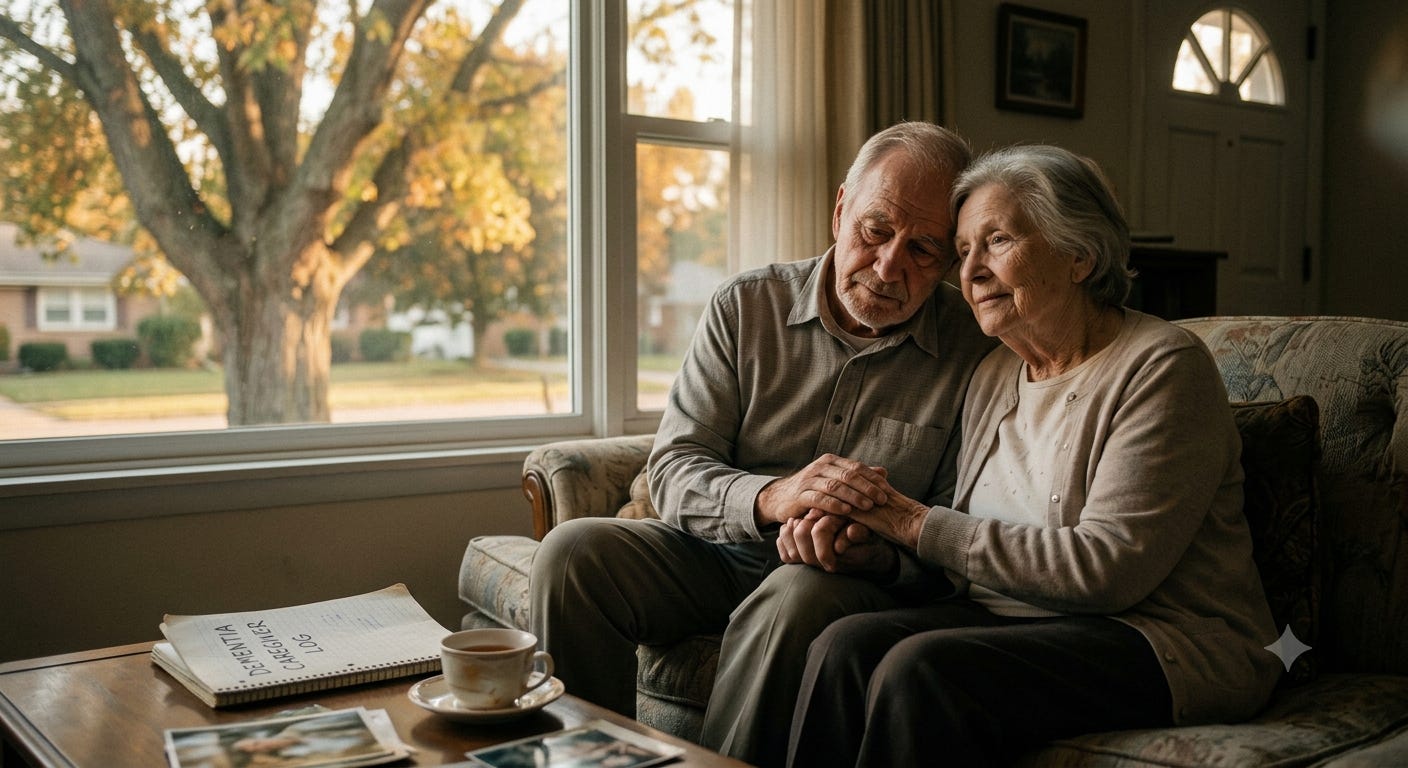
When love is not enough
My mother was formally diagnosed with Alzheimer’s at the age of 57. We had noticed changes in her behaviour a couple of years earlier, but a diagnosis has a way of making an unwelcome possibility real.
For several years my father, who was eight years older than Mum, cared for her in their home. My wife went regularly to help around the house. At the time we had a baby daughter, and then two boys arrived in quick succession. We had three very young children ourselves, but we did what families do: we helped where we could.
Then Mum began to wander.
Dad did his best to stop her, but dementia does not respect locks, schedules or a carer’s need to sleep. On more than one occasion we had to call the police to help search for her. Thankfully she was found safe. We never worked out how she had got as far as she did, wearing a nightgown and slippers.
My sister and I tried to tell Dad that this was no longer manageable at home. He would not have a bar of it.
He believed it was his job to care for his wife. That was not stubbornness in the ordinary sense. It came from devotion, from the vows he had made and from a generation which took those vows literally. I suspect there was something else too. He knew that people in his social circle would judge him if he put Mum into care.
He was right about that.
The turning point came one night when Mum woke, did not recognise the man beside her, went to the garage, found a large piece of lumber and returned to the bedroom. She aimed a blow at Dad’s head while he slept.
Fortunately, it glanced off the side of his head. He was injured, but a direct strike would probably have killed him.
That is a horrible thing to write about my mother. But it was not really my mother who did it. It was a terrible illness acting through the person we loved. And it made something brutally clear: caring for her now required somebody to be awake and alert 24 hours a day.
There was no way to provide that safely in their home.
It took more than a year for a place to become available. That is another failure, and a very Australian one. We tell families to seek help, then leave them waiting while the crisis deepens. Eventually Mum entered a care home and Dad was alone in the house they had shared.
The carer who could not stop caring
We asked Dad to move in with us. He refused. My wife, now with three primary-school-aged children and a 30-minute drive each way, continued to go over every day or two to help with housework. Some of Dad’s closest friends, who lived nearby, stepped up as well.
Eventually Dad had a fall. He could not get up or reach the phone. He lay there for a couple of days before we found him.
Only then did he agree to move in with us.
We converted our formal lounge into a downstairs master suite. He lived with us for the next eight years, until he died. He had his children and three of his grandchildren around him. Yet he did not really get to enjoy them nor my sister and her two whom he saw even less.
Every day he went to see Mum in the nursing home. Every. Day. When he came back home, he spent much of his time in his room. He joined us for dinner, but not for much else.
He was physically tired and emotionally spent.
That is the part outsiders so often fail to see. The decision to move someone into care does not end the caring. For many families it starts a different, exhausting stage of it: visits, advocacy, guilt, grief, phone calls, medical decisions and the slow loss of the person they knew.
Dad did not place Mum in care because he loved her less. He did it because he had finally accepted that love alone could not keep her safe, or keep him safe.
The judgement of people who have not been there
Outside his closest friends, Dad was criticised for the decision. Some of that criticism came to me and my family as well.
It was not always cruelly said. That almost made it worse. There was a quiet assumption that a sufficiently committed family would cope. That keeping a person at home was simply a matter of will.
Nothing could be further from the truth.
Years later, after both my parents had died, I was in Greece when a cousin pulled us aside. His own mother was by then in the advanced stages of dementia. He told us that he had been critical of our family for putting “his aunt” in a home. Only after he lived through his mother’s illness did he understand.
“His aunt.” As if he had cared more for her than we had cared for our own mother.
I appreciated the honesty. I also thought: this is how easily people pronounce from a safe distance.
Dementia does not merely make somebody forgetful. It can change judgement, sleep, perception, impulse control and behaviour. It can turn a familiar home into a dangerous maze. It can leave an elderly spouse trying to manage emergencies that would overwhelm a team of trained people working shifts.
A home can be the best place for an older person for a long time. With the right support, it often is. But there comes a point for some families when remaining at home is no longer a preference. It is a risk.
The difficult question is not, “Do they want to go home?” Almost everyone would. The difficult question is, “Can they be safe there, and can the people who love them remain safe too?”
A little more mercy
The Melbourne couple’s story is sad because their wish was understandable. They had been married for 65 years. They did not feel comfortable in care. They felt choices were being taken from them. Their daughter had every reason to fear what might happen to two vulnerable people on their own, especially when one believed he could still protect the other.
Those things are not contradictions. They are the tragedy.
We should absolutely demand better aged care: more places, better staffing, more personal attention, more freedom where freedom is safe, and real support for families before they reach breaking point.
But we should stop casually judging the daughter, son, spouse or sibling who makes the decision nobody wanted to make.
Sometimes placing someone in care is not the moment a family gives up.
Sometimes it is the last act of care they have left.