

Last year, Maria and I were driving on the Ionian island of Lefkada. Lefkada is unusual among the Greek islands in that it is connected to the mainland by a causeway, which means you can reach it by car rather than by ferry. This suited us well. I had entered the island name into the GPS, which promptly decided I wanted to visit its geographic centre – most of the way up a mountain, along a road that became steadily narrower and steeper and more committed to the position that turning back was no longer an option.
After an hour of this, the reasonable conclusion was that something had gone wrong. We pulled into one of the mountain villages to have lunch and get our bearings before heading back down to the city we had apparently already driven through.
The village had one taverna. We sat down and ordered: pastitsio for Maria, moussaka for me, both served in individual clay pots. If lasagne had Greek cousins, these would be two of them – pasta and beef under béchamel in one case, eggplant and beef under béchamel in the other. What arrived was, and I do not overstate this, some of the best food either of us had eaten in years.
We said as much to the owner, an older gentleman who came and sat with us for a while to find out where we were from and generally about us. He explained that the ingredients were all local. The vegetables came from his own fields. The meat was from an animal the village butcher had slaughtered. The béchamel was made from scratch, with local butter and local eggs. His wife joined us. He ordered us drinks – a soft drink for me, since I was driving – and when we eventually stood to leave, he would not let us go without first producing a small platter of fruit: melons and apples from the district, drizzled with honey from nearby hives.
What I had intended to be a thirty-minute pit stop became two hours. The food was exceptional, but the food was not really the point. The point was the conversation, the unhurried pace, the couple who sat with us because that is what you do when strangers come to your table and like what you’ve made. The clay pots, the local meat, the eggs in the béchamel – these were part of it, but they were not the thing itself.
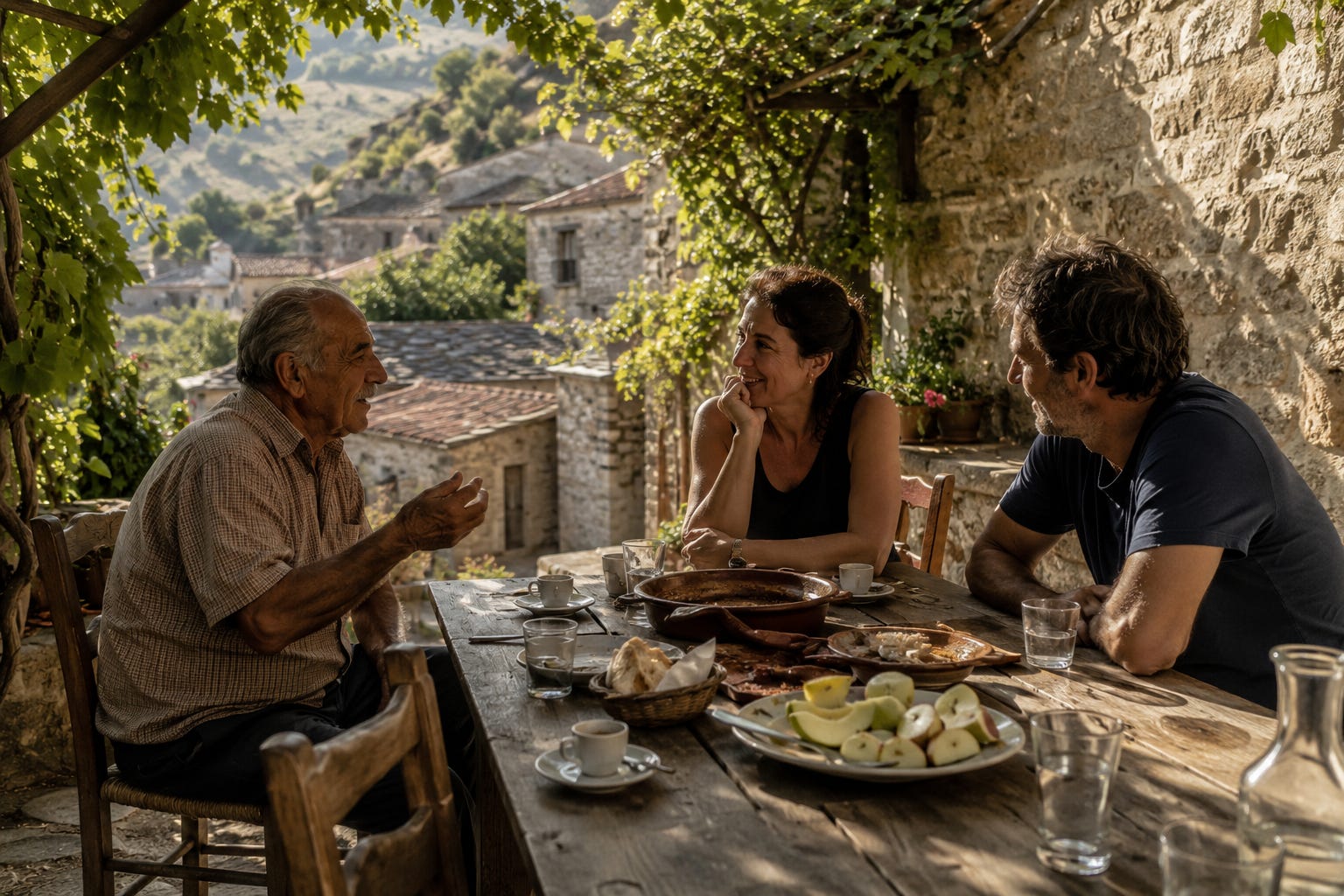
That is the Mediterranean diet. Not the olive oil. Not the legumes or the fish or the fresh vegetables, though all of those matter. The thing itself is what surrounded the food: the time taken, the company, the meal as an event in its own right rather than a problem to be solved between other activities.
In the 1960s, a physiologist named Ancel Keys noticed that populations around the Mediterranean basin had substantially lower rates of heart disease than Americans, and set out to understand why. The answer he found pointed to food: olive oil, fish, legumes, fresh vegetables, moderate wine, not much red meat. The observation was broadly right, and it gave the world a named dietary pattern. What it did not give the world – could not, by its nature – was the context in which that pattern existed and from which it was inseparable. By the time the Mediterranean diet reached the supermarket shelf, it had been reduced to a list of approved ingredients.
That list is not nothing. The science behind it is real enough. As someone managing metabolic health (after thirty years of Type 2 diabetes, I have learned to be wary of both food mythology and food panic. But the people eating this way in Crete and Calabria and the villages of the Peloponnese were not eating it as a health intervention. They were not eating it to lower their LDL or improve their insulin sensitivity. They were eating what was available, in season, locally produced, and they were eating it together, slowly, at a table, without particular anxiety about the outcome.
The anxiety is the thing the West imported that wasn’t in the original. The Mediterranean diet, as it exists in the countries that gave it a name, is not accompanied by calorie counts or macronutrient ratios or the periodic guilt that drives people between restriction and excess. It is accompanied by conversation.
You cannot separate the diet from the culture that produced it. Not fully. You can eat Greek food in Melbourne – and good Greek food is genuinely available in Melbourne, as it is in most cities with a significant Greek-Australian population – and it will be better for you than what it replaced. But the meal in the mountain village on Lefkada was not replicable by buying the right ingredients at a farmers’ market and eating them with some care. It required the owner who grew the vegetables, the wife who sat with us, the two hours, the fruit platter that appeared because you do not let guests leave without one. It required, in other words, the philosophy – the set of values about hospitality, time, food, and other people that the diet expresses but did not invent.
The English word “diet” comes from a Greek word – diaita – that means, roughly, a way of life. Somewhere in the translation, it became a temporary restriction you impose on yourself to achieve a measurable result. That is approximately the opposite of what it started as.
Of course we left a good tip when we finally made our way back down the mountain.
Filotimo works both ways.
This article is a good reminder of Greek hospitality, allowing time to be present and communing with others. My family is from Lefkada, which is the village you had this amazing experience?