

Here is a sentence I did not expect to write: the most intellectually serious institutional document on AI published this year is a papal encyclical.
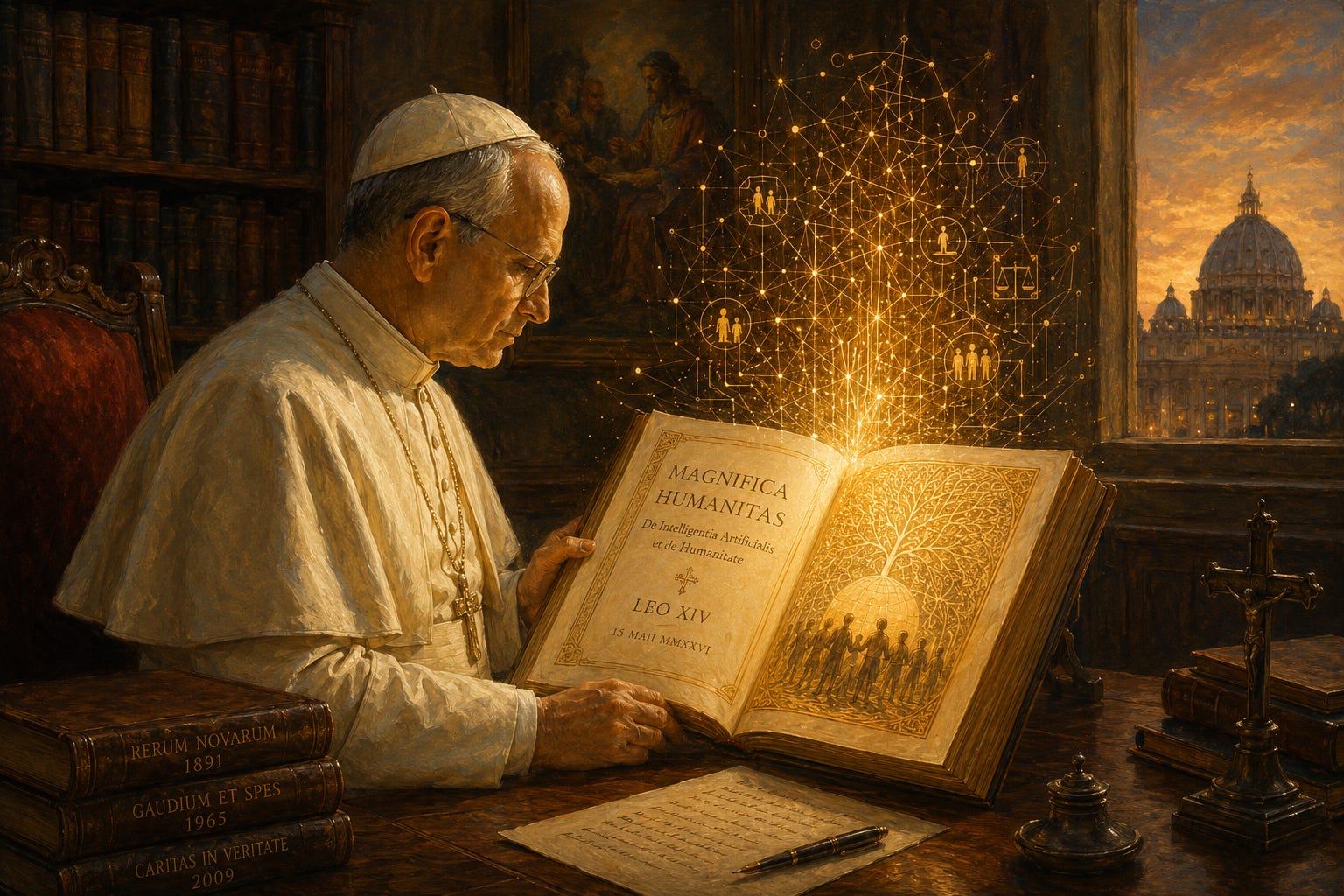
On 15 May 2026, Leo XIV published Magnifica Humanitas – a document dedicated to artificial intelligence and its implications for the human person. He is the first pope to do this. The timing was deliberate: it fell on the 135th anniversary of Leo XIII’s Rerum Novarum, the 1891 encyclical that launched Catholic social teaching as a serious engagement with industrial capitalism. The parallel is pointed. Leo XIV is saying we have been here before, and we have something to contribute.
Whether or not you share his faith, this document deserves your attention. I’d go further: among everything major institutions have put out on AI in the past few years, Magnifica Humanitas is one of the more honest contributions. Several of its arguments will make both AI enthusiasts and AI pessimists uncomfortable. Good. That’s usually a sign someone is thinking clearly.
The most important move Leo XIV makes is early, and it is not a theological one. AI, he argues, is not neutral – not in the abstract philosophical sense that everyone agrees with and then promptly ignores, but in a harder, structural sense. Every AI system embeds choices about what it measures, what it ignores, what it optimises for, and how it classifies people. The values of those who designed it, funded it, and trained it on data are baked in. Calling a system objective does not make it objective. It just conceals whose objectivity you’re dealing with.
This matters enormously for governance. And it leads directly to the encyclical’s first major practical argument.
When consequential decisions – about credit, employment, parole, access to services – get delegated to automated systems, who actually answers for a wrong outcome? The Pope’s answer is: increasingly, no one. The injustice gets “cloaked in a veneer of neutrality and objectivity, against which it becomes difficult to raise objections.” Political responsibility dissolves along with the human face of the decision. His demand in response is simple: algorithmic decisions that affect people’s lives must be transparent, contestable, and subject to genuine human oversight. That is not radical. It is, essentially, the position of the EU AI Act. But it is worth having it stated with this much force.
The second major argument is about power concentration. This is where I think Leo XIV is at his sharpest. He extends a traditional Catholic concept – the “universal destination of goods,” the idea that the earth’s resources belong in some meaningful sense to the whole human family – to cover data, algorithms, patents, and digital infrastructure. Data is produced by many contributors, he says. It cannot be treated as private property to be monopolised by a handful of actors. And right now, those actors are setting the conditions of public life: what is visible, what gets amplified, who gets rewarded, who gets penalised. They are doing this at a scale that exceeds the reach of most democratic institutions. It needs to be named plainly, and he does.
Now, where the encyclical gets distinctively Catholic – and where it will be most interesting to people wrestling with the deeper questions AI raises – is in its account of human limitation.
Leo XIV takes direct aim at transhumanism and posthumanism: the dream of transcending human weakness through technology. His response is not simply “that’s playing God.” It’s more interesting than that. Human limitation, he argues, is not a defect to be corrected. It is the condition under which compassion, wisdom, and genuine relationship become possible. Suffering, failure, vulnerability – these are the crucible in which character forms. He quotes Viktor Frankl on Auschwitz to make the point: the same humanity capable of the gas chambers was capable of entering them upright, with a prayer on its lips. Our greatness and our woundedness are inseparable. You cannot optimise away the second without losing the first.
This results in a critique of a particular promise that runs through a great deal of AI promotion: the implicit suggestion that human messiness, error, and uncertainty are problems to be solved rather than dimensions of a life to be lived. An algorithm treats failure as a flaw to be corrected. For a person, failure can be the beginning of real change. That distinction is worth holding onto.
So what does all this mean in practice? Leo XIV works through three domains: truth, work, and freedom.
On truth: AI amplifies disinformation at a scale and speed with no precedent. I have been involved in technology for over four decades, and I have never seen change occur so rapidly. That said, the Pope is not calling for censorship or centralised control – he explicitly argues against that. What he wants is what he calls an “ecology of communication”: strong journalism, transparent content governance, and a cultural commitment to treating truth as a common good rather than a weapon. He quotes Hannah Arendt on totalitarianism – its ideal subjects are not the ideologically convinced but those for whom “the distinction between fact and fiction no longer exists.” That is, obviously, the direction some of this is heading.
On work: automation and AI are displacing workers at speed, de-skilling those who remain, and subjecting them to algorithmic surveillance. The Church’s position since 1891 has been that work is not merely a means of income; it is constitutive of human dignity. Leo XIV holds that line and draws a direct practical implication: every deployment of automation must come with verifiable protections for the workers it affects. Profit cannot be the only measure. Employment is not a by-product of a well-functioning economy – it is a condition of one.
Here is one point where I would perhaps argue that a universal basic income, a significantly shorter definition of what constitutes full-time employment, or perhaps a combination of both, are also viable approaches to addressing this problem.
On freedom: the “attention economy” is not a neutral side-effect of digital business models. It is a system deliberately engineered to exploit psychological vulnerability for commercial gain. The Pope calls it what it is: a structural injustice, particularly when it targets children. He wants legal protections. So do I, for what it’s worth.
Leo XIV’s phrase for all of this is “disarming AI” – freeing it from the logic of geopolitical and commercial arms races, opening it to democratic debate, and making it genuinely accessible rather than controlled by whoever currently runs the data centres. Regulation alone will not do it. The deeper move requires treating AI as something that belongs to all of us, not just to those with the infrastructure to run it.
You don’t have to share his theology to see that this argument is both serious and urgent. Whether it goes anywhere is another question entirely.
But it should.