

Not long after Code is Design came out, an email told me the book had “caught our attention”. The sender ran a select group of authors of “unique and innovative books”, and they would love me to join. Members promoted each other’s work. There was, of course, a small fee: $200.
I deleted it, and a second one like it, without much thought. Reading Joe Dunthorne’s piece in the Guardian this month, I realised I’d been lucky they were so clumsy [1].
Dunthorne, a novelist, gets fan mail almost every day: long, warm, well-informed emails from readers in Barcelona, Chicago and Warsaw who love his “deadpan genius”. All of it is written by AI, and all of it ends in an offer to promote his books if he sends a few hundred dollars. The line that stopped me came from a writer friend he quotes: “the reason I know they’re fake is because they’ve actually read all my books.”
We were all taught the same tells. Bad spelling. “Dear Sir/Madam.” A Nigerian prince. An urgent deadline. Those tells were never really the point. They were the cost of a scammer writing in a second language, in a hurry, to thousands of people at once. AI has removed that cost. A flattering email that knows your work, your town and your last post now costs the sender almost nothing.
So the old advice, to ignore anything you weren’t expecting or check it first, still holds. But “check it” can no longer mean “read it carefully and see if it sounds wrong”. It won’t sound wrong.
What’s left is the ask. However good the writing, every one of these messages has to end by asking you to do something: pay a fee, use a particular payment app, click a link, go and look at an Amazon page. The flattery is free. The request is where the money is. That’s the part to read.
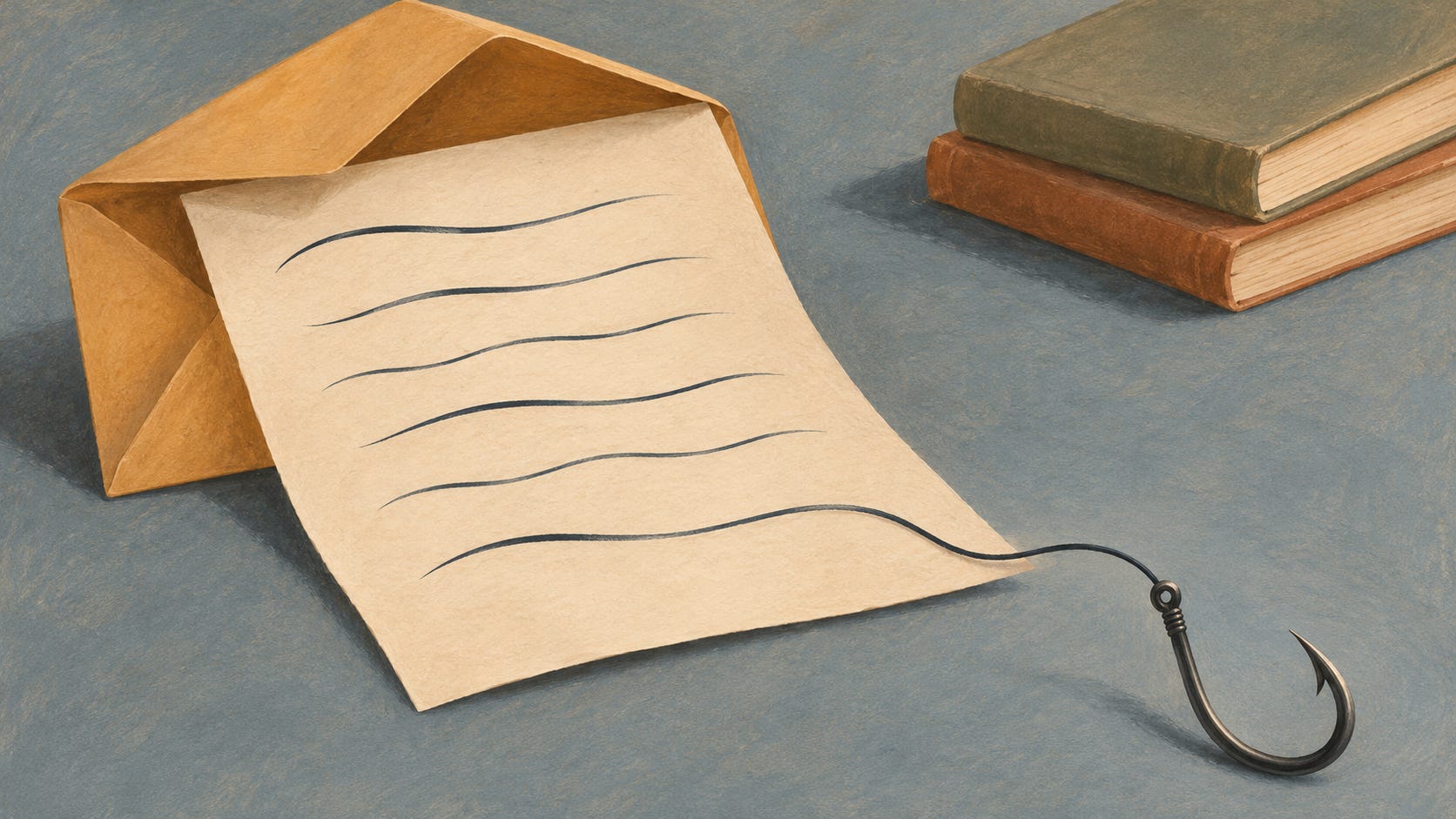
And when the request is real enough to consider, verify it on a channel you choose, not one they give you. Look up the group yourself. Ring the number on the bank’s website, not the one in the email. It’s the same rule I wrote about in the phishing piece last month, and it’s the only one that doesn’t depend on spotting a mistake [2].
The scam used to be in the spelling. Now it’s only in the request.
[1] Joe Dunthorne, “Like many authors, I’m bombarded by scam fan mail. I wasn’t prepared for what would happen when I wrote back”, The Guardian, 1 November 2026
[2] Jim Karabatsos, “The Phishing Scam Sitting Beside Your Dentist Appointment”, Ground Truth, 12 October 2026