

In March 2020, as COVID was turning large parts of the economy off like a switch, I asked a question on Facebook:
What do people think about the concept of a Universal Basic Income?
At the time, the question had an immediate, practical edge. People were losing jobs. Businesses were closing. Governments were suddenly discovering that income support systems designed for normal unemployment were not built for a whole economy put into suspended animation.
In Australia, JobKeeper and the temporary Coronavirus Supplement showed something important. When the emergency was serious enough, governments could move very quickly to put money into people’s hands. The usual lectures about affordability, incentives and personal responsibility became much less convincing once middle-class incomes were also at risk.
For many people, this was not an abstract policy debate. It was rent. Groceries. Medication. School expenses. A mortgage payment. The small humiliations of suddenly needing help after a lifetime of assuming help was for someone else.
COVID exposed something we usually prefer not to examine. In a society organised around wages, income is not just money. It is independence. It is bargaining power. It is the ability to say no. It is the difference between participating in society and applying for permission to survive.
The virus did not create that fragility. It revealed it.
But the question that interested me then was not only about pandemic relief.
It was a larger question, and it has not gone away.
What happens to a society built around wages when the production of the necessities and luxuries of life requires fewer and fewer human workers?
That is the real UBI question.
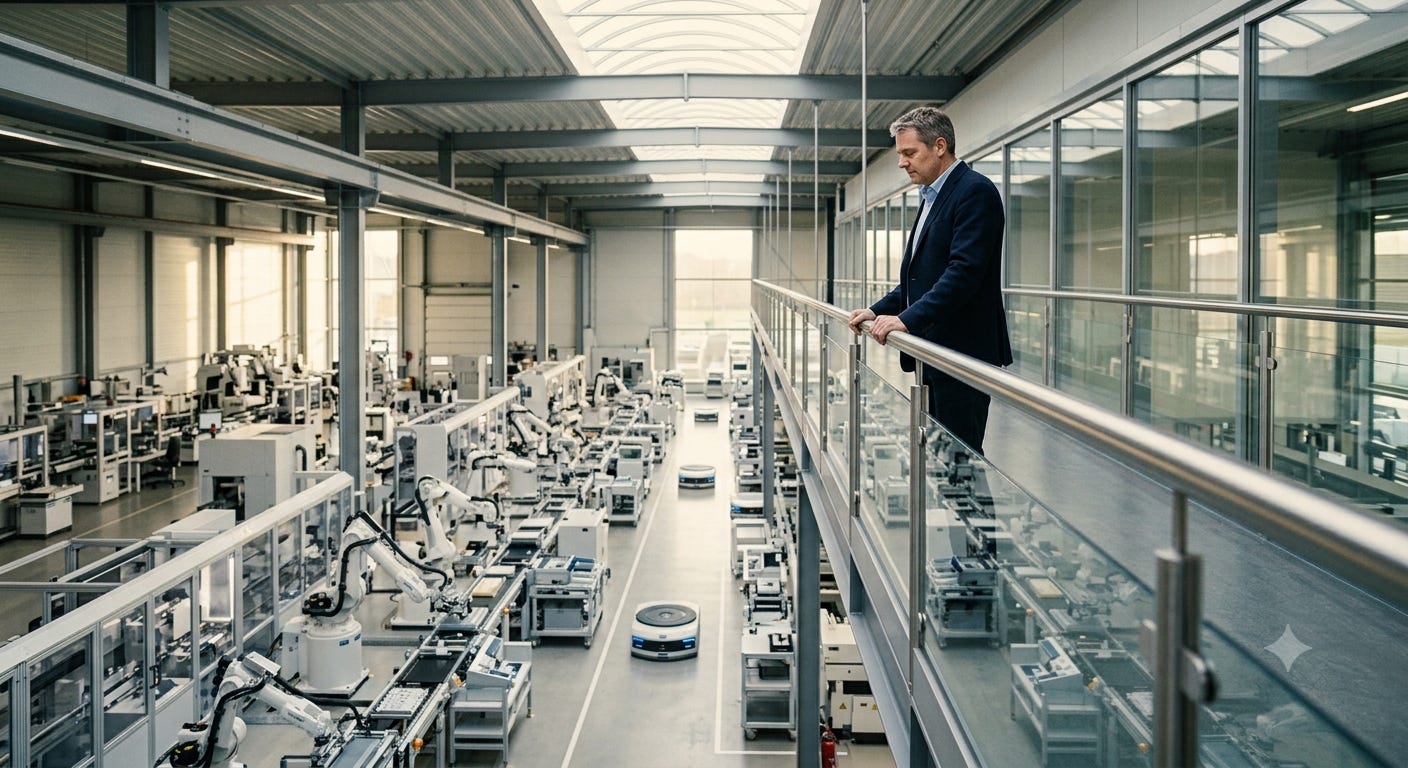
Not whether people should be paid to do nothing. That is the lazy version of the argument. The deeper question is this: if paid labour is no longer needed from everyone, what happens to the people whose need for food, housing, medicine, dignity and participation has not disappeared?
Put another way: how do we distribute the wealth that society can still produce?
For the last few centuries, the answer has mostly been wages. Most people receive their share of national wealth by selling their labour. They then use those wages to buy food, housing, clothing, transport, entertainment, education, services, and all the other things that make up modern life.
That arrangement has worked well enough to become almost invisible. Unevenly, unfairly, and sometimes brutally, but well enough that we now treat it as natural.
It is not natural. It is historical.
And history has changed this arrangement before.
Agriculture changed the question
Before agriculture, human societies were organised around hunting, gathering, kinship, mobility and immediate need. That is not to romanticise hunter-gatherer life. It was not an Edenic picnic with berries and good weather. But the economic structure was different. People generally consumed what they could gather, hunt, make, carry or share.
Agriculture changed that.
Once humans could produce food surpluses, society could support people who were not directly producing food. Priests, kings, soldiers, scribes, merchants, builders, artisans and administrators all became possible because not everyone had to spend every day finding the next meal.
That surplus gave us cities, writing, law, architecture, organised religion, mathematics, taxation, armies, bureaucracy and eventually civilisation as we understand it.
It also gave us hierarchy, land ownership, stored wealth, rents, tribute, slavery, serfdom and organised coercion.
Technological progress is rarely morally simple.
Agriculture created abundance compared with what came before, but it also created the problem of who controlled the surplus. If one group controlled the land, grain stores, irrigation systems, weapons and records, another group could be made to work for access to life’s necessities.
The technology changed the productive base. Society then reorganised around that base.
Not always kindly.
Industrialisation changed it again
For a long period, wealth was tied overwhelmingly to land. In feudal societies, peasants or tenant farmers worked land they did not own and retained part of what they produced. Their survival depended on their relationship to landholders and local power.
Then came industrialisation.
The steam engine, mechanised production, factories, railways, coal, steel and mass manufacturing shifted economic power away from land and towards capital, machinery and wage labour. People moved from villages to cities. They no longer retained a portion of what they grew. They sold their time for wages.
That transition was not smooth. It produced appalling working conditions, child labour, slums, political unrest, union movements, socialist movements, public education, expanded suffrage, labour parties, welfare states and eventually the modern social contract.
The point is not that the Industrial Revolution simply made life better. In the long run, it produced enormous wealth. In the short run, it tore apart older ways of life and created new forms of dependence.
But it also produced a new mechanism for distributing purchasing power: wages.
Industrial capitalism needed workers, but it also needed consumers. If ordinary people had no money, they could not buy the products the factories were producing.
So the wage became more than payment for work. It became the central distribution mechanism of industrial society.
Work in the factory, the office, the shop, the school, the hospital, the mine, the railway, the warehouse – and through wages, receive your share of the goods and services that society produces.
Again, not perfectly. Not fairly. Not universally. But sufficiently to become the organising assumption of modern life.
Now the assumption is under pressure
The information age has been putting pressure on that assumption for decades.
Software replaced clerical work. Robotics changed manufacturing. Logistics systems changed warehousing and retail. Online platforms changed media, travel, advertising, music, publishing and commerce. Algorithms changed finance, recruitment, insurance and customer service.
Now artificial intelligence has arrived as the latest and probably most significant part of that longer process.
AI is not simply another machine replacing muscle. It reaches into language, pattern recognition, programming, analysis, administration, law, medicine, education, design, art and management. It does not replace all of those fields outright. But it changes how much human labour is needed to produce a given result.
That is the key point.
The issue is not whether all jobs disappear next Tuesday. They will not.
The issue is whether the economy increasingly produces more goods and services with less human labour. If it does, wages become a less reliable way to distribute purchasing power.
A society can have full shelves, automated farms, robot warehouses, AI-designed products, self-service systems, automated transport, algorithmic management and astonishing productive capacity – while still leaving large numbers of people without adequate income.
That is not because the society is poor.
It is because the distribution mechanism is failing.
The old question: who gets the surplus?
Every major technological transition returns us to the same question.
Who gets the surplus?
In agricultural societies, the surplus was often captured by landowners, kings, temples and states.
In industrial societies, the surplus was contested between capital and labour. Unions, strikes, labour parties, welfare systems, public education, progressive taxation and social democracy were all, in their different ways, attempts to answer the question: how much of the wealth produced by industrial capitalism should flow back to the people whose lives were shaped by it?
The automation age asks the question again.
If machines, software, AI systems, data centres, robots and networks produce more of what we need, who receives the benefit?
Only the owners?
Only shareholders?
Only the companies that control the platforms, models, infrastructure, patents and data?
Or does some part of that productivity belong to the society that made it possible?
That is where the idea of a Universal Basic Income becomes interesting.
At its best, UBI is not charity. It is not welfare in the narrow sense. It is not a grudging payment to the unsuccessful.
It is closer to what Thomas Paine and later Henry George were reaching for in the idea of a citizen’s dividend: a recognition that some portion of wealth arises not from individual effort alone, but from common inheritance – land, resources, law, public infrastructure, accumulated knowledge, language, science, technology, education and generations of social cooperation.
No company invented mathematics. No billionaire invented the legal system that protects property. No platform created the internet from nothing. No AI company created the entire body of human text, art, code, science, culture and conversation on which its systems depend.
Private enterprise matters. Innovation matters. Risk matters. Organisation matters.
But so does the common inheritance.
A citizen’s dividend says that if our shared civilisation produces an ever-rising surplus, every citizen has some claim on that surplus.
That, to me, is the moral foundation of UBI.
But UBI cannot mean abandoning people
There is, however, a serious trap.
One version of UBI says: give every adult a flat payment and abolish all other welfare.
There is something attractive about that. It would sweep away a humiliating and expensive bureaucracy. No more endless forms, compliance tests, punitive surveillance, mutual obligation theatre, poverty traps, arbitrary eligibility rules, or armies of administrators paid to decide whether desperate people are sufficiently deserving.
A universal payment is simple. It is unconditional. It does not punish someone for taking casual work. It does not require the unemployed to perform despair for the state. It does not treat poverty as a character defect.
But the phrase “replace all welfare” hides a problem.
People do not all have the same needs.
A healthy adult with no dependants does not have the same needs as a person with severe disability. A single renter in an expensive city does not have the same needs as someone who owns a home outright. A carer looking after a disabled child or elderly parent does not have the same needs as someone with no caring responsibilities. A remote community does not face the same costs as an inner-city suburb.
If UBI becomes an excuse to abolish targeted support for people with greater needs, it fails morally.
So the better model is not simply “UBI replaces everything”.
The better model is this: UBI provides the income floor, while the state guarantees the necessities of a dignified life.
That means health care. Education. Disability support. Aged care. Housing security. Public transport where practical. Digital access. Child support. Care infrastructure. The things without which a person cannot realistically participate in society.
In Australia, that distinction matters because we already accept part of it. Medicare is not a cash payment. Public education is not a cash payment. The Pharmaceutical Benefits Scheme is not a cash payment. The NDIS, despite its many problems, is based on the recognition that disability support cannot be reduced to “here is the same amount everyone else gets; good luck”.
A serious UBI would have to sit within that broader architecture.
Cash for ordinary life. Public provision for essential human need.
Would people stop working?
The most common objection to UBI is that people would stop working.
Some would.
That answer is not as frightening as it is meant to be.
Some people would stop doing work that is pointless, degrading, badly paid or harmful. Some would leave jobs that only exist because people are desperate enough to take them. Some would spend more time caring for children, parents, partners, neighbours, or themselves. Some would study. Some would start small businesses. Some would make art, music, gardens, software, furniture, meals, clubs and communities. Some would do very little for a while because they are exhausted.
We should be honest about that.
But we should also ask why we are so attached to the idea that survival must be conditional on labour, even when that labour is not socially necessary.
There is a difference between work and employment.
Raising children is work. Caring for a dying parent is work. Maintaining a community organisation is work. Learning is work. Creating is work. Volunteering is work. Mentoring is work. Preserving culture is work. Being a decent neighbour is work.
The market recognises some of these things only when they are packaged, priced and sold. That does not mean the unpaid versions have no value.
A society less dependent on compulsory wage labour may not be a society without work. It may be a society in which we finally admit that employment has never been the only form of contribution.
Can we afford it?
The practical objection is cost.
A full UBI is expensive. There is no point pretending otherwise.
But cost depends on design.
A UBI can replace some existing payments. It can reduce some administrative overhead. It can be taxed back from higher earners through the income and corporate tax systems. It can be introduced gradually. It can begin as a partial payment. It can be linked to resource revenues, carbon dividends, land value taxation, sovereign wealth funds, or taxes on economic rents.
In Australia, we have particular reasons to think about this. We are a resource-rich country. We already have a relatively centralised tax and transfer system. We already provide universal health care in principle, if not always in practice. We already understand the aged pension as a broad social entitlement rather than a personal moral failure.
We also have an expensive, punitive and often absurd welfare compliance system.
The question is not whether a perfect UBI can be dropped from the sky next Monday.
It cannot.
The question is whether we can begin moving towards a system where every citizen has an unconditional income floor, while the necessities of dignified life are secured collectively.
That might begin through increases to existing universal or near-universal payments. It might begin with children. It might begin with older citizens. It might begin with a carbon dividend or resource dividend. It might begin with a negative income tax. It might begin during the next economic shock, just as COVID forced governments to do previously unthinkable things in a matter of weeks.
Political feasibility often arrives disguised as emergency.
Inflation and housing
There is one objection that deserves more attention than it usually receives: inflation.
If everyone receives more cash, but the supply of essential goods does not increase, prices may rise. This is especially true for housing.
A UBI paid into a broken housing market could become a landlord subsidy. Give tenants more money, and rents may simply rise to absorb it.
That is not an argument against UBI. It is an argument against thinking about UBI in isolation.
Income policy cannot substitute for housing policy. A citizen’s dividend cannot fix monopolies, rent-seeking, land speculation, health bottlenecks, or underbuilt infrastructure by itself.
If the necessities of life are privately rationed through scarcity pricing, any cash payment risks being captured by those who control access to necessity.
So UBI must be part of a larger settlement.
It must sit alongside housing reform, public services, competition policy, infrastructure investment and serious taxation of economic rents.
Otherwise, we may simply pour public money into private tollbooths.
The politics will be difficult
UBI attracts strange coalitions.
Some on the left like it because it reduces poverty, strengthens workers’ bargaining power, recognises unpaid care and treats people with dignity.
Some libertarians like it because it could simplify welfare, reduce bureaucracy and give individuals cash instead of state-managed services.
Some in Silicon Valley like it because they can see that automation may undermine the consumer base on which their own businesses ultimately depend.
But those coalitions fracture quickly over the details.
Is UBI a supplement to public services or a replacement for them?
Is it funded by taxing wealth and economic rents, or by cutting support for the vulnerable?
Is it a genuine citizen’s dividend, or a cheap payment that lets employers offer worse jobs and governments abandon responsibility?
Is it enough to live on, or merely enough to pacify people?
These questions matter.
A bad UBI could be worse than no UBI. It could become a tool for dismantling the welfare state while leaving people to fend for themselves in rigged markets.
A good UBI would do the opposite. It would reduce coercion. It would make survival less dependent on pleasing an employer, a bureaucrat, or an algorithm. It would give people a base from which to participate in society.
That is the distinction.
UBI should not be hush money for a discarded workforce.
It should be a share in the productivity of a society that no longer needs everyone’s labour in the old way.
The unavoidable question
I am mildly, cautiously, conditionally in favour of UBI.
Not because I think it is simple. It is not.
Not because I think it solves everything. It does not.
Not because I think everyone will use it wisely. They will not. But that has never been the standard applied to tax cuts, inheritances, corporate subsidies, negative gearing, capital gains concessions, or executive bonuses.
I am in favour of taking it seriously because the question behind it is becoming unavoidable.
For most of the industrial age, the wage system did two things at once. It organised production, and it distributed purchasing power.
Automation weakens that link.
If fewer people are needed to produce the goods and services society wants, insisting that everyone must obtain income through paid employment becomes increasingly irrational. We can try to preserve the old model with make-work, surveillance welfare, insecure gig work, pointless compliance rituals and moral lectures about self-reliance.
Or we can ask a more adult question.
If our machines, systems, institutions, knowledge and accumulated civilisation can produce abundance, how should that abundance be shared?
Agriculture forced one answer. Industrialisation forced another.
The information age – and now AI – may force the next.
Universal Basic Income may not be the final answer. It may not even be the best phrase. Perhaps citizen’s dividend captures the moral idea better. Perhaps we will arrive there through a negative income tax, public services, resource dividends, or some hybrid we have not yet named.
But the central issue will not go away.
If human labour is no longer necessary at the scale it once was, human survival cannot remain conditional on selling labour.
That is the conversation we need to have.
Not someday.
Now.