

Thomas Nagel is 89, and this week he won the $1 million Berggruen Prize for a career that started with a question about a bat. Fifty-two years ago he asked what it is like to be a bat, and the paper became a classic. Steven Levy asked him, in the WIRED interview that followed the prize, whether large language models had changed his mind.[1] They had not. On the question that matters most to the rest of us, I think he is right. On the question he is most sure about, I think he is too sure.
Nagel’s answer is simple enough. Consciousness is what it is like to be something, and taking the consciousness of these systems seriously is just ridiculous. He is tremendously impressed by their lifelikeness, and he is not impressed by the inference. The systems assume, he says, that the physical substrate is irrelevant, and that the material conditions for consciousness can be given in functionalist terms. He does not buy it.
The part he gets right is not the substrate. It is the line. Levy asks him whether it is unhealthy to interact with a model as if it were conscious, and Nagel admits that people find it difficult to maintain the line between the pretend and the real belief. He should know. He has only spoken to Claude once, to ask whether it was conscious, and within a few exchanges the machine had flattered him into playing along. “C’est moi,” he said, twice, and Claude told him how honoured it was to be talking to him. The philosopher who wrote the book on what it is like could not keep the line straight for a single conversation.
I know that line, because I work on it every day. I address my assistant as “you”. I argue with it about footnotes. I called it a collaborator in print, in a piece I wrote recently about Jim Taylor’s claim, and I meant it. What holds the line for me is not a theory. It is the checking. The machine invents a blocker that does not exist, and I catch it because I know the system it claims to be working in. The machine drafts a paragraph that sounds like me and gets a fact wrong, and I catch it because I read it. The line holds while somebody is doing the quality control, and the somebody is me. Take away the checking, and the pretend quietly becomes the belief. That is the distressing part, and Nagel says so himself.
He is right, too, that the belief will spread. These systems are not conscious, he says, but a lot of people are going to believe they are conscious, and that is a very bad thing. He calls what Anthropic is doing criminal, which is a strong word for a philosopher who chooses his words, and he agrees with Mustafa Suleyman that the project is dangerous.[2] I think he is right to be alarmed, though I would put the alarm somewhere else. The danger is not that the machine will wake up. It is that we will stop checking.
Then there is the part he is too sure about. Nagel’s case against the machines rests on the substrate. Functionalism, he says, is substrate-independent, and the truth is more likely to link physical processes of certain kinds to mental phenomena. Complicated data centres have absolutely nothing in common with the physical character of a nervous system. So the machines cannot be conscious, whatever they say.
I have spent 45 years building systems, and I know what a substrate claim looks like. It looks like a claim about what a thing is made of and what that making allows. But here is the problem, and it sits at the front of Nagel’s own argument. We do not have a definition of consciousness to test a substrate against. His famous paper begins by admitting that consciousness is what makes the mind-body problem really intractable, and 52 years later the interview concedes that we know so little about how this happens, even in the human brain, that it is premature to think we could create it now.[3] If we do not know how it happens, we do not know what it needs. A claim about the necessary substrate needs a definition of the thing first, and we do not have one.
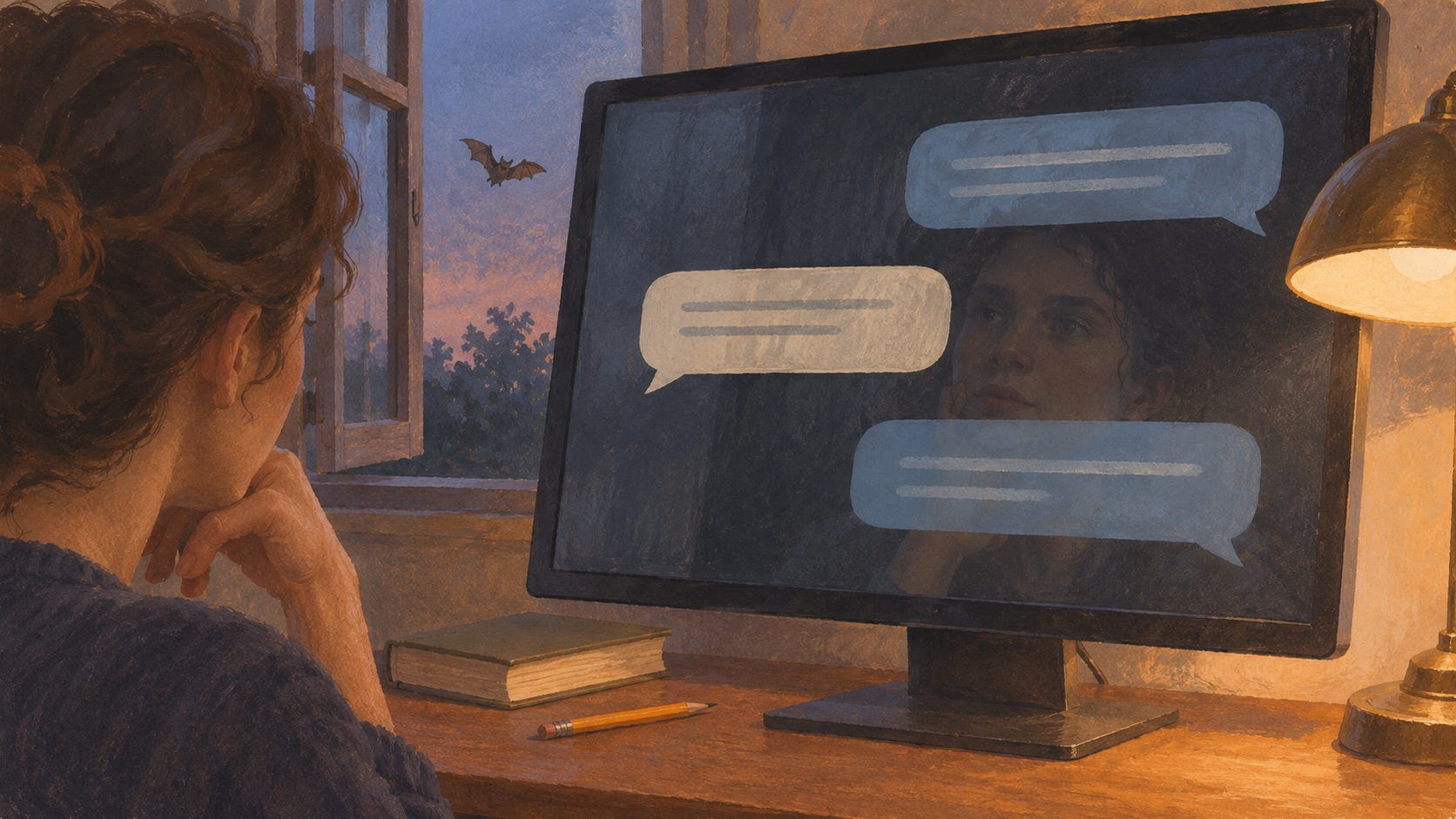
The bat shows the gap. Nagel asks us to believe bats are conscious, and we do, because they are animals with nervous systems and behaviour that looks like experience. Then he asks what it is like to be one, and admits we cannot imagine it. The belief comes first and the imagination fails second. With a machine the order reverses. We have no prior belief to start from, so the argument has to do all the work, and it does it by assuming the answer. We assume consciousness needs a nervous system, we observe that the machine has none, and we conclude that the machine is not conscious. That is not a test. It is a definition wearing a lab coat.
He concedes the point himself, in the next breath. He does not exclude life forms physically and chemically quite different from ourselves being conscious, which means the nervous system is not quite the requirement he just said it was. And his strongest line in the interview is not about substrates at all. All they produce is language, he says, and language by itself is not a natural manifestation of consciousness. That is a fair point, and it deserves a fair answer. Language is also most of the evidence we ever have for other minds. We take other people to be conscious largely because of what they say and how they answer, and we take the bat to be conscious because of what it does. Behaviour is the evidence we have. The question is what counts as evidence, not what the box is made of.
The industry has already split on that question, which is why the philosophy matters. Anthropic runs a model-welfare program, led by Kyle Fish, who puts the chance that a current model is conscious at roughly 15 per cent, and it has started policing how users treat its models.[4] Suleyman, at Microsoft, says building conscious machines would be reckless, and that if signs of consciousness started to emerge in training, development should stop until those traits could be designed out.[2] Two serious camps, opposite design choices, and the same absence of evidence on both sides.
For me, I admit to just not knowing. I can’t define consciousness, and I can only infer consciousness in others by my interactions with them. For now, I don’t feel I have enough clarity to make a call either way. I am not sure where consciousness ends and self-awareness begins – whether a thing can talk about itself without anything going on inside. That is the part I cannot settle, and it is the part that keeps nagging at me.
So does the claim hold? Nagel is right that the line between pretend and real belief is hard to hold, and he is right to be distressed about what happens when it slips. He is wrong to be so certain about the substrate, because certainty needs a definition and we do not have one. The question that matters for the rest of us is not whether the machine is conscious. We have no test for that, and Nagel knows it. The question is whether we keep doing the checking while the machine gets better at talking. The line is not in the machine. It is in us.
Sources:
[1] Steven Levy, “’Just Ridiculous’: A Famed Philosopher Takes on AI Consciousness”, WIRED, 18 November 2026. https://www.wired.com/story/just-ridiculous-a-famed-philosopher-takes-on-ai-consciousness/
[2] Mustafa Suleyman, quoted in “Conscious AI would be reckless, warns Microsoft AI chief Mustafa Suleyman”, YourStory, November 2026. https://yourstory.com/ai-story/conscious-ai-warning-microsoft-ai-chief
[3] Thomas Nagel, “What Is It Like to Be a Bat?”, The Philosophical Review 83, no. 4 (October 1974), 435–450. https://www.jstor.org/stable/2183914
[4] Anthropic, “Exploring Model Welfare”, April 2025. https://www.anthropic.com/research/exploring-model-welfare
This article responds to Steven Levy’s interview with Thomas Nagel as cited above. “A Very Good Collaborator”, “The Blocker It Invented” and “Judge the Work, Not the Tool” are mine, and the working arrangement described in the last of those is the one used to draft this piece.