

The moment is called seiza. In our dojo, when the sensei called the class to attention, it required kneeling on the left knee and placing both hands on the right. Simple enough if your knees are functioning as designed. Mine were not.
I had spent decades carrying far more weight than a human skeleton is built for, and my knees had kept the account. Kneeling on one of them was, by this point, genuinely painful – not uncomfortable, not challenging, but the kind of pain that makes you think carefully about the next fifteen seconds. Getting back up required my hands, and it was not graceful. Nothing about it was.
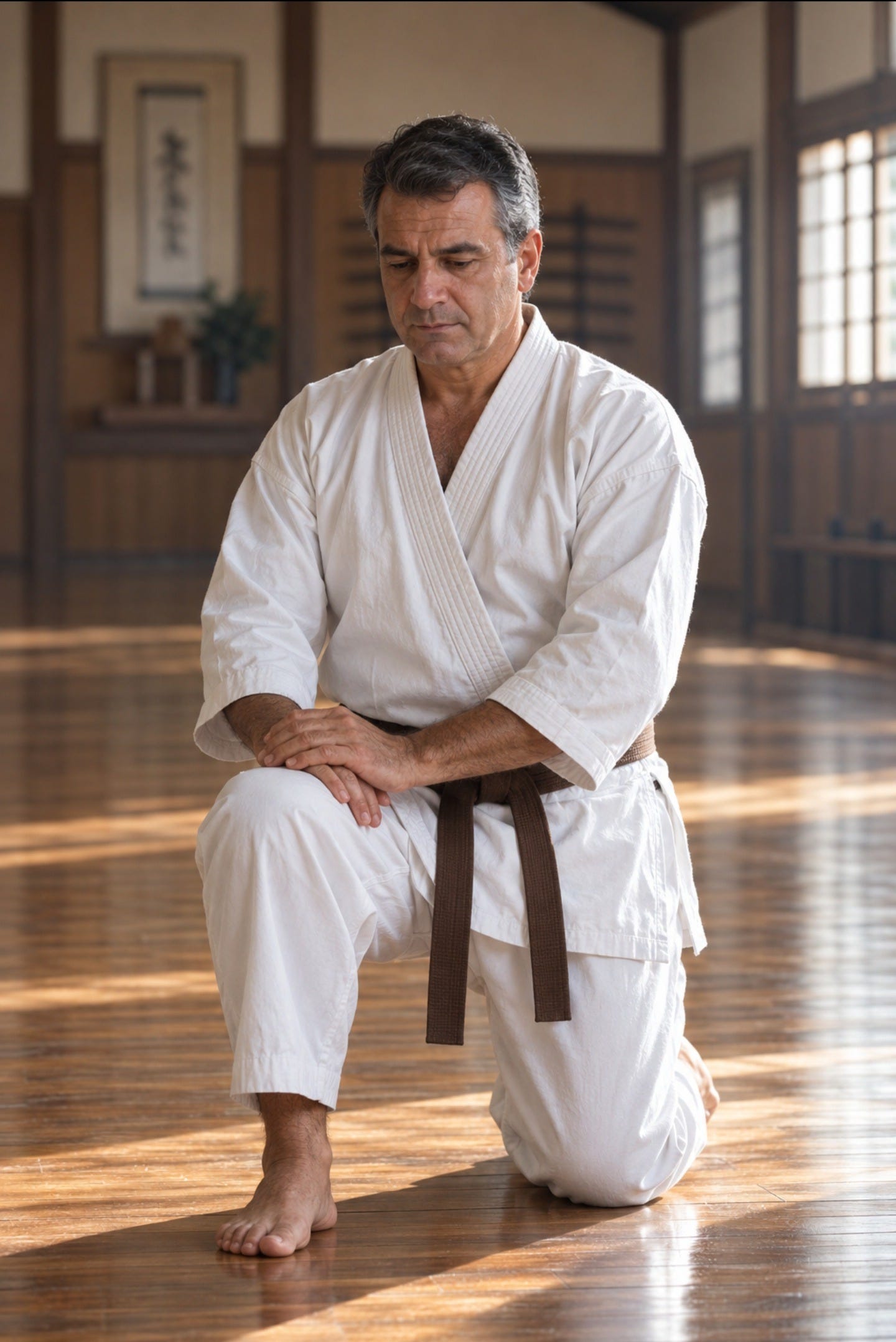
I could have mentioned this to the sensei or the instructors. They would almost certainly have made allowances – martial arts dojos, in my experience, are not unsympathetic to physical constraints. But that was exactly what I did not want. I had started karate alongside Maria and our three children because I wanted to do what everyone else was doing, not a modified version of it. So I said nothing. I knelt when we knelt. I got up when we got up. And I did it, if I am honest, with a particular kind of stubbornness that I have come to recognise as a core feature of my character rather than a commendable quality.
How I ended up in a dojo in my late forties is a longer story that belongs elsewhere – it was part of a period of significant change that included surgery and a serious reckoning with what I had done to my body over twenty years of Type 2 diabetes and a peak weight approaching 160 kilograms. The short version is that the surgery started the weight loss and the karate continued it, and somewhere in the middle of all of that I found myself training seriously for the first time in my adult life. The long version is covered in my recently published book, The Long Road Down.
What I want to talk about here is what the dojo teaches that nowhere else does.
A dojo has a particular relationship to failure that the professional world does not. When you get something wrong in a meeting, there are usually ways to manage it – to nod carefully, to let the moment pass, to note that you will follow up. When you get something wrong in a kata, there is no managing it. Everyone in the room can see it. The sensei can see it. You can feel it before you are corrected. The gap between knowing how something should look and being able to make your body do it is one of the more humbling experiences available to an adult, and it does not get less humbling with repetition. You become more competent. You do not become less aware of the gap.
This is, I came to understand, useful. Not in the vague sense of something being broadly beneficial, but in the specific sense that it corrects something decades of professional life tend to instil. The adult professional world rewards the appearance of competence as much as competence itself. The dojo has no mechanism for the appearance of competence. You can either execute the technique or you cannot, and the class is watching.
The seiza problem stayed with me for a long time. I never mentioned it, never asked for accommodation, and gradually – as the weight came down and the knees recovered some of what they had lost – it became less of an ordeal and then simply something I did. That progression taught me something I am not sure I could have learned any other way: that certain difficulties are designed to be endured rather than solved, and that enduring them with some dignity is itself a form of progress.
There is also something specific about doing this as a family. Maria and I trained together in the adult classes; our three children were in the junior classes, on their own mat with their own instructors, working through their own gradings. We were not all in the same room. But we were all in the same building, pursuing the same thing, and we compared notes. Whatever I can claim to have modelled about starting something difficult and not stopping – I had witnesses. That, it turns out, is not a small thing.
We reached first kyu – one step below black belt – and decided, Maria and I, that this was where we would stop. Not because the next step was unavailable, but because we were realistic about what reaching it would require and honest about whether we needed it. We had done something we had not quite set out to do at all, but had arrived at anyway. First kyu, at our ages, alongside each other and our children, was enough. Not a consolation. Enough.
The things karate taught that carried forward are not dramatic. They are the ordinary discoveries of anyone who takes up something genuinely difficult late in life: that the body is more capable than the mind believes, that public correction is survivable and often useful, that progress is measured in months not sessions, that the appropriate response to being a beginner is to be a beginner and not to perform competence you don’t yet have.
None of these are insights that would surprise anyone.
The difference is that I know them in my knees.