

On Monday I wrote about a problem I met again and again in my working life: people believe a number because a computer produced it.[1] This week brought a new twist on it.
The Western Australian government paid Deloitte $166,000 for a feasibility study on merging three universities. Earlier this month it emerged that the report contained references that did not exist. Now the Guardian has found that some of its sums are wrong too.[2]
Under one scenario, the report puts the costs up to “day one” of a merger at $514 million and the costs over the following five years at $145 million. Added together, that is $659 million. The report says $399 million. Under another scenario, $396 million plus $116 million becomes $823 million. Those are not rounding errors. One is $260 million out, the other $311 million.
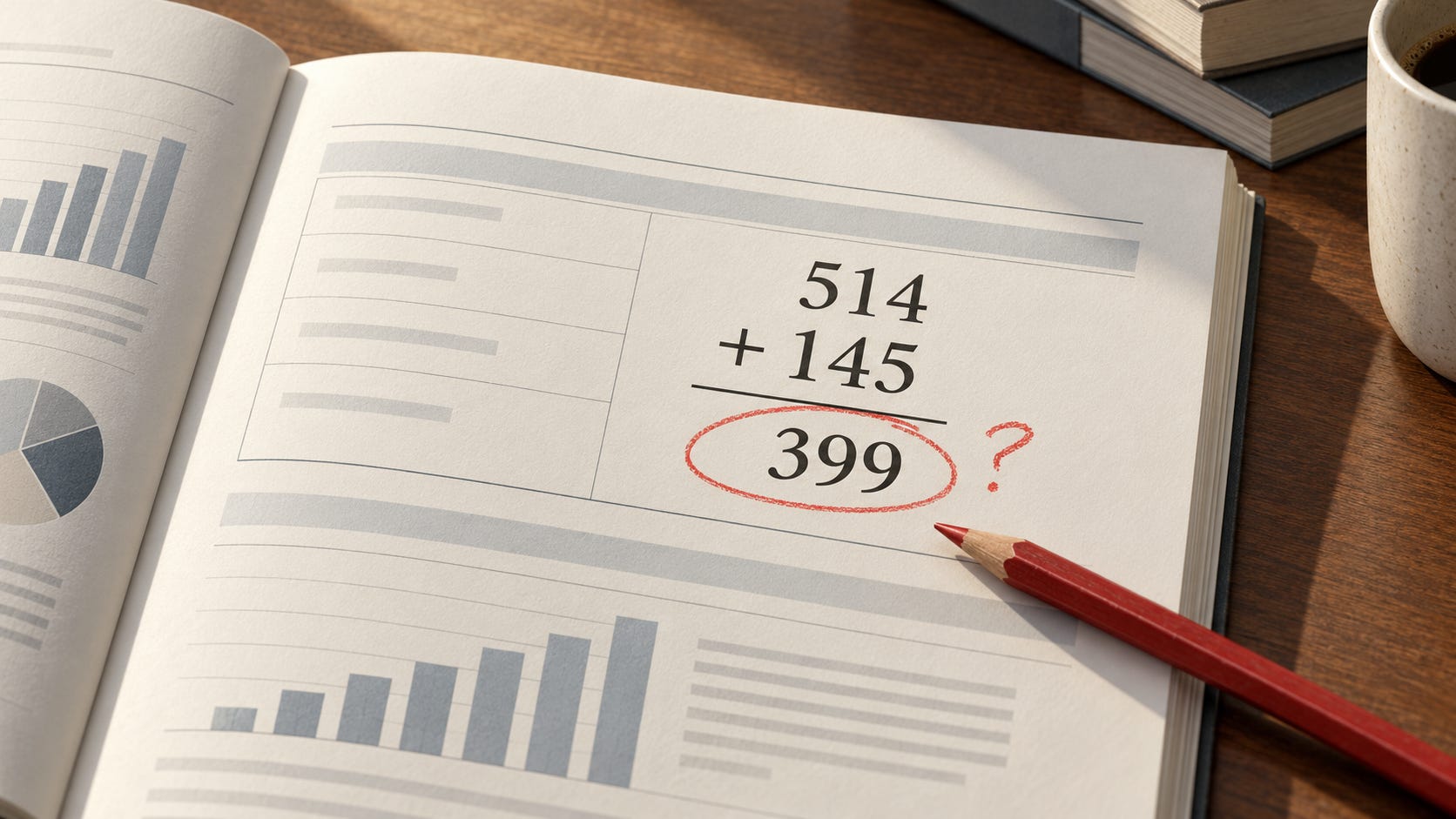
Deloitte says it used generative AI to “support the collation of research, synthesis of information and editorial proofing”. Nobody has said the AI produced the wrong totals, and I won’t claim it did. But the episode shows how much has quietly changed about where numbers come from.
For most of my career, a number in a report came out of a spreadsheet or a system. The inputs might be stale or incomplete, and that was the argument I kept losing. But at least the machine had done the arithmetic. If it said two figures added to a total, they did.
A number in a document is different. It is text. Someone, or something, typed it. A language model does not add numbers up. It writes text that looks like numbers that have been added up, and most of the time it looks right. A tired consultant copying figures between drafts can do the same damage. Either way, the total carries the authority of a polished report, and the authority is borrowed.
The government says it has been advised the errors “do not affect the modelling in the report or its findings”. Perhaps. But if the totals in the appendix were wrong, it is fair to ask which numbers the findings were resting on.
The habit I was trying to break in my users was trusting a number because of where it came from. The answer is the same now as it was then: check it. With a report like this, that means the most basic check of all. Do the numbers add up?
[1]: “Would You Mind Leaving the Room?”, 26 October 2026.
[2]: “’Extremely disappointed’: WA government seeks reimbursement from Deloitte over flawed university report”, Guardian Australia, 26 October 2026.