

Whenever automation comes up, somebody asks what people will do.
The question assumes employment is the only thing keeping people from staring at a wall. Take away the need to earn a wage and, apparently, most of us will stop contributing.
I do not think so.
Some people will choose to do very little. They already do. But most people want to be useful. They want to make, repair, organise, teach, write, look after people, build a business, learn something difficult or leave some mark beyond their own comfort.

The problem with work is not that people hate all of it. The problem is that too much work is done under conditions that leave people little room to choose what they are good at, what they value, or what kind of life they want around it.
That is the human question automation forces us to confront. Not whether machines can do more. They plainly can. The question is whether we will use them to give people more control over their lives, or simply to make fewer people produce more while everyone else is told to be grateful for whatever remains.
I retired at fifty-nine.
At the time, I had been in the same company for far longer than is normal in the IT industry. I was the most senior member of the team after the CEO. I still provided technical input into products and projects, but if I am being brutally honest, my main contribution had become protecting the development teams from the constant barrage of project-management theatre so that they could get on with their work.
I was also doing some development consulting on the side. Partly to keep my technical skills current. Partly because I enjoyed coding. Not the management and sales side of the business – coding.
You could have fairly called me a workaholic.
Then one morning, a workmate of roughly my age did not come in. We contacted him, concerned. His wife had died in her sleep the night before. She was in her early fifties, fit, with no known health problems.
In the following month, two close relatives were diagnosed with breast cancer. Both are thankfully well today. But by then the message had arrived with sufficient force. Our time is limited, and worse, we do not know how limited.
My wife and I did some serious thinking. Our children were growing up and would soon leave home. I had not been an absent father, but I had missed more of their lives than I should have. We decided to get off the treadmill.
We made a five-year plan. We downsized, simplified and changed our habits. In 2017, taking long-service leave, we went to Greece and bought an apartment with the intention of spending a substantial part of each Australian winter there. The plan was to return to Australia in November, and I would resign before the end of the year.
Then the plan shifted.
As part of buying the apartment, we had agreed to let the previous owners remain there for six months. So we thought I might as well continue working until March, then return to Greece to take possession, renovate and furnish the place.
We arrived back in Australia on a Thursday. I was due back at work on Monday.
On Friday, an email arrived from the CEO. It began by welcoming me back. It then launched into a list of things I needed to attend to when I returned.
The effect was physical.
After three months in Greece – good food, Mediterranean weather, a slower rhythm, time without work pressing into every corner – my stress had gradually drained away without me quite noticing. Reading that email, I felt it come back all at once.
I told my wife the March plan was cancelled.
On Monday, I handed in my resignation.
I stayed until the Christmas break, about five weeks, and handed over as much as I could as smoothly as I could. But I was done.
You do not always notice stress when it is constant. You may not even notice it rising slowly. But when it returns suddenly after an absence, you know exactly what it is.
Retirement did not mean doing nothing. For a while, my old company called regularly with short consulting requests. I took a few of them. They were only a few days at a time, but I did not enjoy them. Eventually I kept increasing my asking rate until it became frankly outrageous and they stopped asking.
That was not because I had lost the ability to work. It was because I had acquired the ability to choose.
I thought about what I actually enjoyed and realised it was teaching and public speaking. I had done plenty of commercial training but had no formal training qualification, so I completed a Certificate IV in Training and Assessment. I had entered IT before there were meaningful software-development degrees, and did not have a degree myself, so I also completed a Diploma in Web Development.
Over the following years, including through the COVID lockdowns, I took occasional ten-week teaching engagements at two local TAFE colleges. I taught in Victorian correctional facilities. I worked with people entering the industry or trying to build a different future.
Was I retired?
Absolutely.
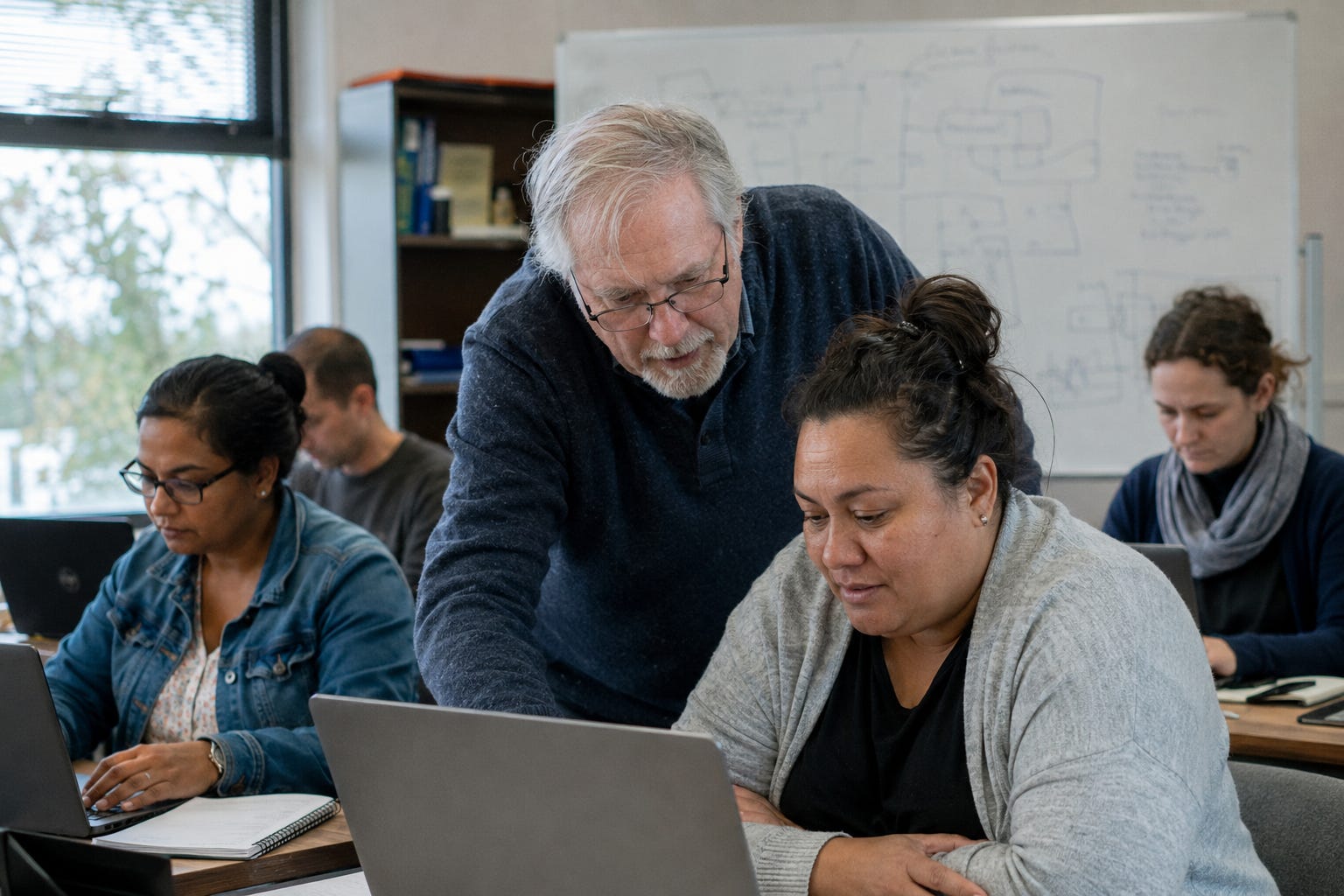
I was not sitting at home. I was not going fishing – a pastime whose appeal has always escaped me. But I was working on my own terms. I took engagements when they suited our travel plans and other commitments. My wife did something similar, occasionally filling short-term vacancies at the medical practice where she had worked, because she enjoyed the patients and the staff.
We were paid, of course. The money was welcome.
But we had already budgeted for retirement. It was not the reason we said yes.
The reason was purpose. The pleasure of being competent at something. The satisfaction of giving back to younger people some of what we had absorbed from those who came before us.
That is work too.
The mistake is to confuse employment with contribution. This is where many arguments about automation become muddled.
People who worry about the loss of jobs are right about one thing: a job often provides more than income. It provides routine, colleagues, a reason to get up, a place in the world and evidence that somebody needs what you can do.
But it does not follow that we must preserve every job simply because it exists.
Some work is draining, dangerous, repetitive or poorly matched to the person doing it. Some people stay in work they dislike because a mortgage, children, illness or simple financial reality gives them no room to change direction. Others are kept in roles where their skills are ignored because changing paths would mean risking the little security they have.
That is not dignity. It is necessity.
Nor should we romanticise the workplace simply because it gives structure. Organisations often talk warmly about their people while treating them as interchangeable. I have seen more than one senior employee identified as “above the band” by people studying a spreadsheet. Someone apparently carrying the same qualifications could be hired more cheaply, so the older person was moved on.
Then the trouble began.
The replacement may have had the right technical skills on paper. What they did not have was the historic knowledge, the cultural knowledge, the judgement accumulated through years of seeing how a particular organisation actually worked.
The disasters that followed were predictable.
The irony is that businesses regularly preach efficiency while discarding the very people who know where the risks are buried. Then, when something fails, they discover that competence was not as interchangeable as the salary bands suggested.
AI will intensify this temptation. If an organisation thinks it can replace experience with a cheaper person assisted by a machine, it may well try. Sometimes it will succeed. Often it will discover that the visible task was never the whole job.
This is why I am more sympathetic to a universal basic income than many people expect. I feel we should give people security, then let them build a life.
The practical argument for it is straightforward. If automation produces enough wealth to reduce the need for human labour, then people should not be made destitute merely because the economy no longer requires them to sell forty hours a week to survive.
But the deeper argument is about freedom.
Give people enough to live a dignified, not an extravagant, life. Remove the constant anxiety of food, rent, bills and a roof over their heads. Then allow them to decide what they can contribute.
Some will build businesses. Some will study. Some will write, make music, paint, care for family members, conduct research, volunteer, travel or explore. Some will work in industries that still need people. Some will teach the next generation.
People do not need a boss to develop a sense of purpose. They need enough security to pursue it.
That does not mean everybody will make noble or productive choices every day. Nor does it mean money alone cures loneliness, depression, exclusion or a lack of direction. A decent society will still need schools, community institutions, libraries, clubs, training, mentoring, public spaces and real paths into participation.
But first it must remove the fear.
We have spent generations telling people that their value is measured by their job title, salary and willingness to keep running on the treadmill. Automation gives us the chance to question that arrangement.
It would be a waste to use extraordinary machines merely to preserve the old insecurity more efficiently.
The best outcome is not a future in which nobody works.
It is a future in which fewer people are forced to spend their lives doing work that leaves no room for the work they were actually meant to do.
Also on the blog since last week’s issue:
Care shouldn’t be three hours away
Remote surgery could bring specialist treatment closer to regional patients. The local hospital still has to be able to deliver it.
I could spend a whole day being busy and leave the important work for the evening. I still recognise the habit.
Jim Taylor calls ChatGPT the best collaborator he has ever had. I spent a day collaborating with mine last week, so I checked his list against that day.
What Is It Like to Be a Chatbot?
Thomas Nagel says taking AI consciousness seriously is just ridiculous. He is right about the hard part, and too sure about the rest.
On 3 November the Board raised rates by six votes to three. The minutes, released on Tuesday, show what the three were actually worried about.